If I Were A Lich, Man is one of three Jewish role playing games released in a collection by the same name created by Lucian Kahn, a fellow transgender Jewish person. When a friend first shared the game with me, I couldn’t help but be curious about its contents. The physical copy of the game includes four themed dreidels, and a deck of character cards featuring artwork by Ezra Rose. The game intends to join aspects of Jewish culture and classic fantasy RPG tropes, namely the titular lich, an undead wizard-type monster that has a connection to Judaism by way of the phylactery, a word that by Jewish definition means tefillin–a set of boxes with prayer scrolls inside used for Jewish ritual–and by fantasy definition means an artifact or device that contains the lich’s soul, and is the key to their reanimation. I am exactly the target demographic for this game, so naturally, I ordered a copy, and last weekend I had the opportunity to sit down with some friends to play.
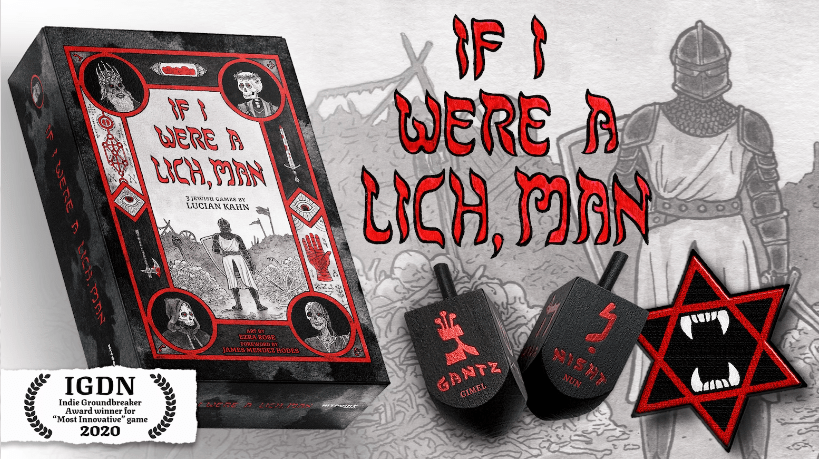
Before the game even begins the instruction booklet includes a primer written by James Mendez Hodes that ushers the players into a healthy mindset when playing the games. Hodes acknowledges that Judaism contains multitudes, and that this game is not intended to be universal. He explains some of the sensitivities that may come up for Jewish people during gameplay so that non-Jewish players don’t accidentally offend anyone at the table, and introduces the concept of liches, the b’net mitzvah (for the second game, Same Bat Time, Same Bat Mitzvah), and includes a detailed explanation of why orcs are omitted from the base game on the final pages of the booklet, pointing out the harmful stereotypes that they allude to.
Overall, the primer is extremely helpful, but my group found it lacking in one key aspect: the rules provide explanations on what not to do, but very little on what players should do. There’s no instruction on how players should build the world they’re about to spend an hour role playing in. This is a “role playing” game in the truest sense of the word; there are no stats, and the dreidels only serve to randomize minor elements of the game. Players are asked to take on a role, and play that part during an hour-long discussion, and then the game ends. It’s more of an acting exercise than a role playing game, especially compared to games like Dungeons & Dragons and Talisman. Thankfully, my playgroup was composed of theater people, but all the players remarked that If I Were A Lich, Man didn’t feel like much of a “game” by the end of our play session.
I think this lack of direction is intended to be a double edged sword. By not clarifying much about the world the game is set in metaphors can take on different meanings in different play sessions. What other creatures exist in the world of your game, and the liches’ relationships with them, are nebulous and to be determined by the players in an improv-like agreement. When I brought up goblins as a potential ally in our play session, the other players kicked the idea around in a very “yes and” like manner. The only constants between sessions are that the liches are a metaphor for Jewish people, and the paladins are a stand-in for white supremacists. However, even with those defined metaphors, and the explicit instruction that this game isn’t about the Middle East, I definitely got the sense that these definitions seemed to creep from the intended targets. That one of the two conflicts players are supposed to discuss involves a fight over territory, and one of the liches bears a pin that reads “I ❤️ Pals” in their artwork, does not do enough to distance the conversation from modern conflicts. I know they intended it to mean “paladins,” but it’s easily misinterpreted as “Palestine.”
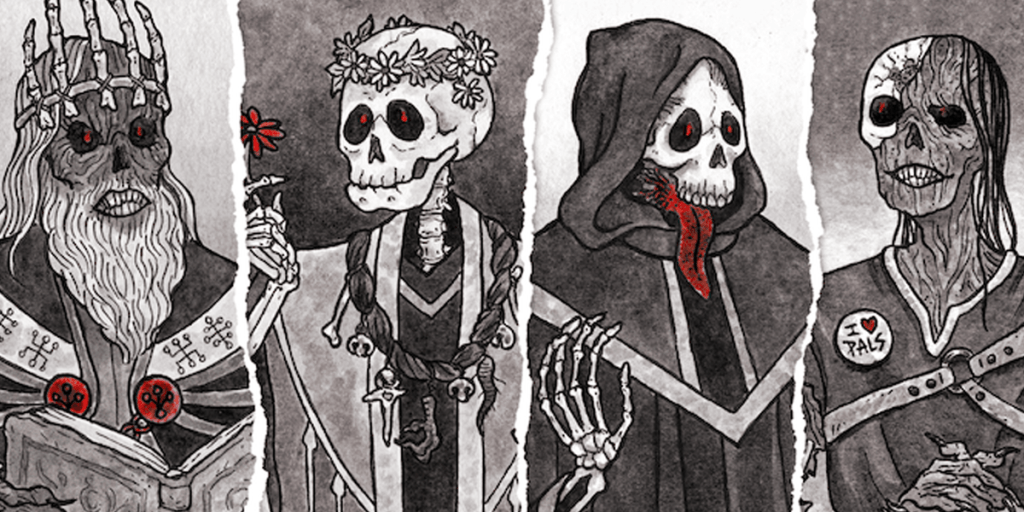
The gameplay instructions are otherwise quite brief. Four players take on the role of four sibling liches: the Good Lich, the Wicked Lich, the Simple Lich, and the Lich Who Doesn’t Know How to Ask Questions, archetypes that any Jewish person will recognize as the four children from Passover. The role cards provide each lich with their opinions on the two subjects of debate: whether phylacteries should continue to be used, and what to do about the conflict with the paladins. Before the debate, each Lich spins a dreidel and invents a happy memory they share with the lich corresponding with the face it lands on, to better establish the relationships between the liches. There are also rules for what should be used as phylacteries, although our table elected to use a precious personal item rather than the glasses of food-coloring tinted water per the instructions.
Once roles are cast and connections are established, the debate commences, with 30 minutes being allotted to each topic. It’s a lot of time to spend arguing about a single subject, and as creative as our playgroup was, we quickly found ourselves talking in circles. This is another major flaw of the game: because each role is given an extreme, contrasting opinion, there’s really no opportunity to compromise. In some ways, this reflects what Jewish debate is like, but practically it meant that no one felt they could give any ground to a differing opinion. If I Were A Lich, Man shares a lot of it’s design with Cosmocracy, another debate-based tabletop game, except in Cosmocracy there is far more variation in the debate topics, and because only two players debate at a time, there’s an audience of impartial voters to determine the winner at the end. Because the liches vote on their own debates, the Simple Lich gets to be the only somewhat impartial voice.
As previously mentioned, the metaphor in I Were A Lich, Man is muddy. The game is designed to encourage a post-game discussion to dissect the decisions that were made, and the format of discussion. Our group ultimately decided that we would fend off the encroaching paladins for now (one player suggested that they were literally at our doorstep and we ran with it), but we would seek help from the goblins in the future. Without knowing exactly what those goblins were representing though, that resolution feels a little weak. I think the game would be improved by including a preamble to the discussion where the shared world is defined in advance so things are established before they come up during the discussion. Without that, the whole game feels quite loose, and didn’t exactly succeed in its goal of tackling difficult subjects with humor and levity.
The use of the dreidels is probably the most disappointing part of the game. Besides randomizing who has memories with who, and determining who decides what is voted on, they serve no purpose. Our table elected to use the dreidels to determine roles for each player, but it feels like a real missed opportunity considering how beautiful they are. Surely there’s room for a spinning d4 (four sided die) to do more in the game than randomly select a player. The different faces only reference the different characters, and their meanings from the Hanukkah game have no bearing on this one. While the game intentionally doesn’t feature points or a score, the debate could be enhanced by including gamified elements, like tokens that liches put into the center when they wish to speak, and letting them spin the dreidel to reclaim their tokens in order to speak more.
On the other hand, I think the game’s instructions are written very well, where they are provided. The introduction to the game asks players to pass the booklet around the table and read from it like one would from a Haggadah at a Passover seder, and designates the Good Lich as the leader of the meeting, instructing them to spin the dreidel first, and later spin again to designate the opening speaker. These actions feel very inspired by Jewish rituals, and certainly made me chuckle, although the joke required some explaining to my non-Jewish friends. I think that’s what ultimately makes the game feel like such a let-down. Clearly a lot of thought has gone into writing the text surrounding this game, but not enough of it is used to direct players towards having a meaningful time with it.
Overall If I Were A Lich, Man is a mixed bag. The game is a thoughtful attempt at translating a Jewish experience for both Jewish and non-Jewish players, but the actual gameplay falls short of providing a meaningful experience. The right group can have a good time with it, but the right group can have fun improvising any scenario. I really enjoyed reading the short essays included in the instruction booklet, and I honestly wish the rules of the game were as deep and thought provoking. I may try playing this game again with my family the next time the holidays roll around, but my first play left a lot to be desired. I don’t see If I Were A Lich, Man entering the regular rotation of games at my game night, and unfortunately, the other games included in the collection don’t seem to be much deeper. As the liches might say, it’s alle ziben glicken—not all it’s cracked up to be.
 Sam Wolfe is alive