Few creators are as inscrutable as Hayao Miyazaki. The serious, weary persona the Japanese animator wears in interviews is a harsh contrast to the dream-like worlds and charming characters found in his films. An outspoken traditionalist, Miyazaki has extolled the merits of hand drawn animation over computer generated visuals, and the results speak for themselves; it’s no mystery why GKIDS re-releases his works in theaters every year, as audiences are drawn to the beautiful line work, fluid animation, and the comfort of a familiar story. This week, however, I had the opportunity for a rare treat, one I may never have the chance to experience again: seeing an unfamiliar film directed by Hayao Miyazaki in theaters. I have been loosely following the development of The Boy and the Heron (2023) since its early days, and I couldn’t have been more excited to see the finished story.
The following review contains spoilers for The Boy and the Heron (2023).
When 12-year old Mahito’s life in Tokyo is uprooted after his mother’s death in a tragic firebombing, he moves to a quiet estate in the country, where his father plans to remarry and start anew. Mahito struggles to find his footing in this new environment, getting into a fight on his first day of school, and then inflicting further injury on himself with a stone against his temple. His situation is complicated, however, when a talking Grey Heron invites him to explore a mysterious tower on the premises with taunting cries that Mahito’s mother is still alive. What follows is an exploration of grief and how creativity can keep our loved ones with us forever in the form of a quest through a wonderland within the mysterious tower. Mahito meets characters both strange and familiar as he seeks his missing step mother for his father’s sake, and comes face to face with the creator of this world, his great grand uncle.
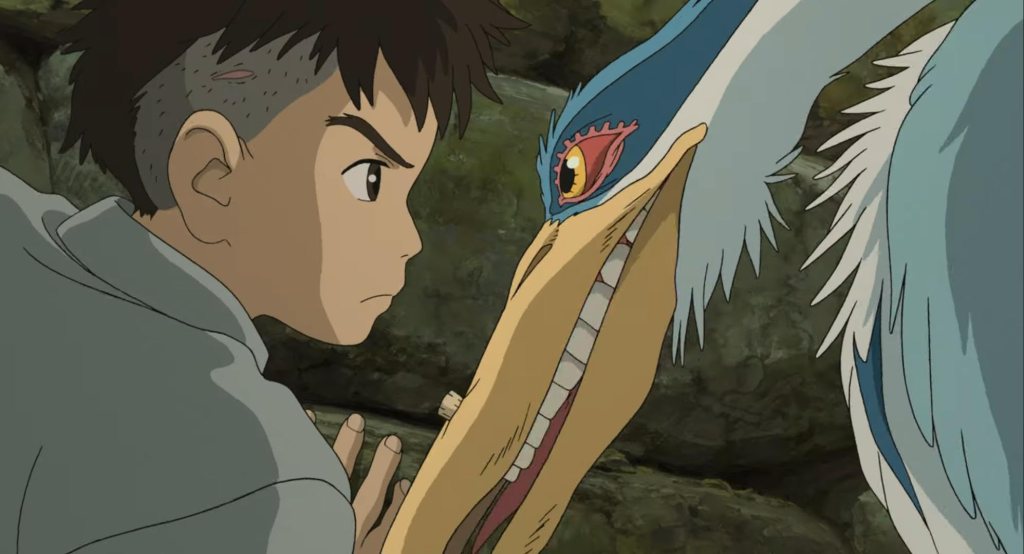
The Boy and the Heron feels like a return to form for Miyazaki. His previous film, The Wind Rises (2013) was a deep character study of a passionate inventor, and substituted the whimsical and sweeping set pieces studio Ghibli is known for for a more grounded, realistic depiction of the world, save for a few dream sequences. Right out of the gate, The Boy and the Heron is breathtaking. The visuals in the firebombing scene are visceral and mercurial, and express the mental anguish of Mahito, and the people around him, in a very tactile way. The world within the tower also feels reminiscent of previous settings featured in Miyazaki’s work, like the bathhouse from Spirited Away (2001), and Laputa from Castle in the Sky (1986). I especially appreciated how frightening some of the visuals were in the first third of the film; seeing the Grey Heron with a mouth full of flat human teeth, and the frogs and fish that climb all over Mahito’s body chanting “come with us,” reminded me how movies made in the late 80’s and early 90’s inspired a little fear in their audiences before wonder, like the tunnel scene in Willy Wonka & the Chocolate Factory (1971).
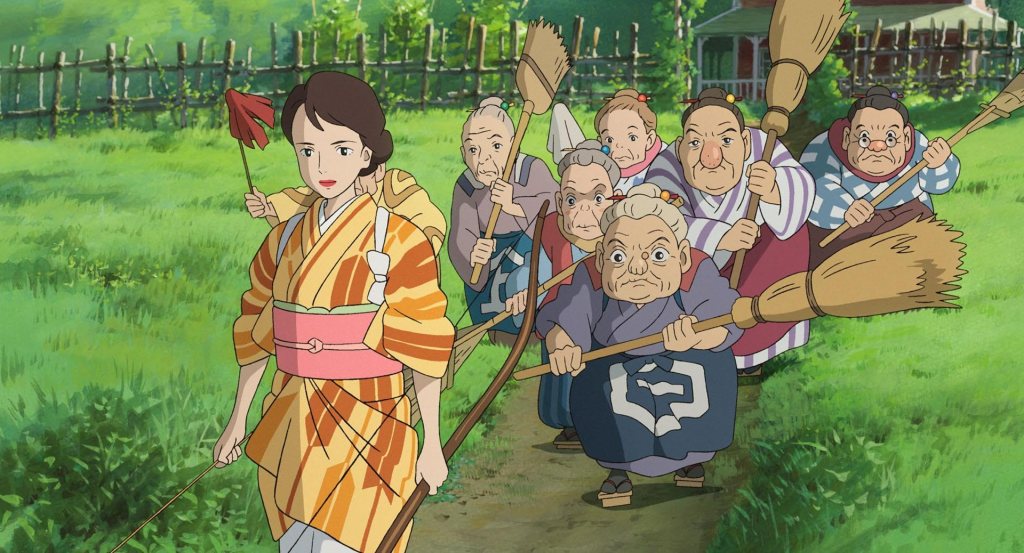
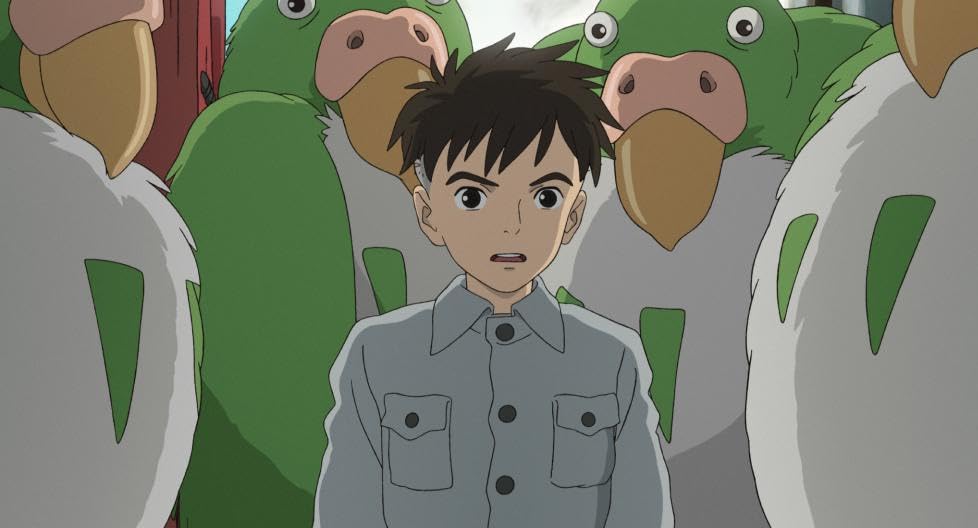
Miyazaki’s character designs and personalities are as delightful as ever. I love how old women are depicted in studio Ghibli movies, and The Boy and the Heron was no exception. Mahito’s step mother Natsuko is accompanied by seven elderly maids, and they stole the show for me. I love how playfully the Japanese actors voiced their lines, and that Miyazaki characterizes them as helpful and resilient, both in their depictions as a search party armed with brooms and rakes, and guardian dolls within the world of the tower. My favorite of the six was naturally Kiriko, a woman who gets a bit more screen time than the other maids, but her brassy personality was immediately charming to me, and seeing her both inside and outside of the tower gave depth to her personality. The creature designs are also excellent additions to the Ghibli canon. Birds are a visual theme throughout the movie, and it seems like the animators put a considerable effort in giving the birds realistic movements, giving both the more realistic pelicans and the anthropomorphic budgies each their own unique visual appeal.
While watching the film, I couldn’t help but read a parallel meaning in the story. The plot surrounding the Granduncle searching for a successor to run the world inside the tower felt like it reflected Hayao Miyazaki’s relationship with his son, Goro Miyazaki. That the entire world was suspended on a precarious tower of thirteen magical stones feels like a direct reference to Hayao Miyazaki’s own filmography; Miyazaki has directed thirteen feature films, if you include the Conan, the Boy in Future (1979) compilation movie. As a whole the movie felt like there was a finality to its tone, as if trying to impart an eternal message to Miyazaki’s real world successor, his son. Extrapolating out this reading I started to see the hungry budgies as merchandisers and licensors, different pieces of the business that allow for the creator to make his world.
Besides reading the film as an allegory for Miyazaki’s film empire, I also found I agreed more with another reading of the world inside the tower: the tower is a space beyond time in which the artist leaves timeless impressions of themselves, and the people they care about. Mahito even receives a final message from his mother in the form of a book with the same title as the Japanese title of the movie, ‘How Do You Live?’, illustrating how media can connect us to people we’re no longer able to be with in person. These readings don’t have to be mutually exclusive, and Miyazaki could have intended the story to work on multiple interpretive levels.
Watching this film I couldn’t help but feel a sense of mourning as it ended. My Neighbor Totoro (1988) was the first anime that I can remember watching, and with each subsequent film, studio Ghibli whisked my imagination away to a wondrous parallel place. Watching with adult eyes, I found myself drawn to reading the text in a way that prevented me from being fully transported, despite the movie having all the hallmarks of another classic from my youth. I felt as though a part of me grew up watching this movie, perhaps suspecting that it may be the last feature length film directed by the brilliant animator. I felt like I could sense myself losing something I can never get back; melancholy is another theme explored in Miyazaki’s works. But although I may continue to change and lose the wide eyed vision I had as a child, I have no doubt that I can revisit the stories of my youth and still see the impression of the person who sparked my love of anime. And who knows? Miyazaki has come out of retirement so many times, who can say if this will truly be his final film?
 Sam Wolfe is alive