The early 2000’s was a wild time for digital media. The onset of commercially available video editing software, particularly Windows Movie Maker, brought video editing into consumers’ hands, and many aspiring editors thought to pair their favorite anime with popular English language music in a now widely recognized form: AMVs. AMVs, or anime music videos, are largely a fan-driven exercise; songs and animation sequences are used without permission from the licensor, leading to an underground and somewhat hard to enter scene. These videos often couldn’t be uploaded to a site like Youtube due to copyright claims, no matter how transformative the editing process was, and to be honest, I can understand why the copyright holders, who wanted complete control of the distribution and presentation of their works, were hesitant to embrace these rogue edits. However, sometime in high school, a friend showed me a DVD featuring an incredible AMV, one that spanned an entire album of work. I couldn’t believe it when they told me it was an official collaboration between the band and the animation studio. This week I’m taking a look at the classic Toei OVA, Interstella 5555: The 5tory of the 5ecret 5tar 5ystem (2003).
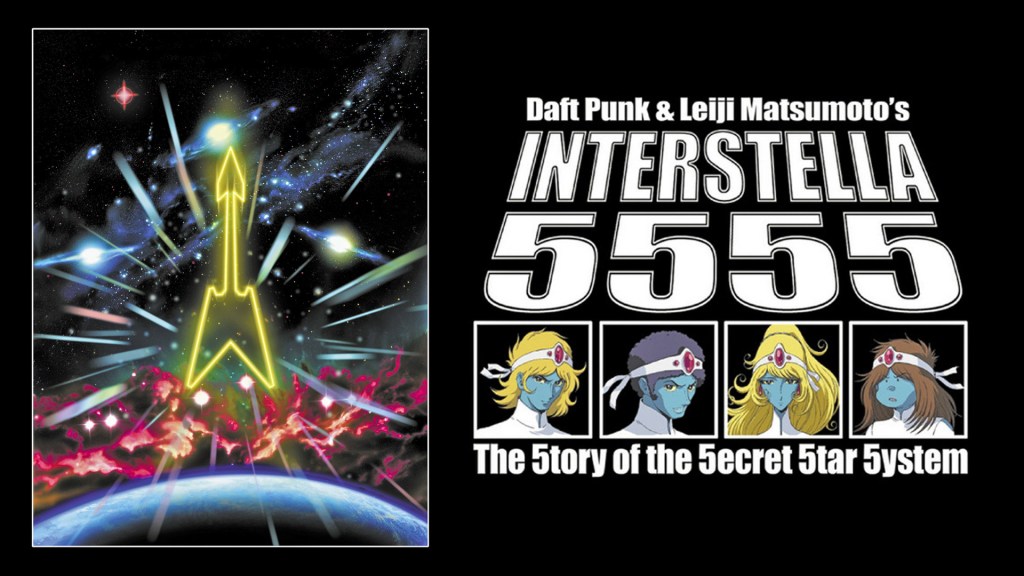
Interstella 5555 is a collaboration between Japanese anime producer Toei Animation and French electronic musical duo Daft Punk. It should come as no surprise to anyone familiar with the anime industry that the project was initiated by Daft Punk, who planned to make a feature film to visualize their album Discovery (2001). Originally, the film was to be live action, but eventually the project transitioned to animation, and after considering several styles of animation, landed on Leiji Matsumoto’s classic anime aesthetic. The marriage of science fiction with the entertainment industry was written by Daft Punk, who then brought the script to Tokyo in the summer of 2000 in the hopes of courting an animation producer. They found a willing collaborator in Matsumoto himself, who saw a spiritual kinship with this project because his animations were originally inspired by French film makers. With Leiji Matsumoto on board as the visual supervisor, a team including Shinji Shimizu as lead producer and Kazuhisa Takenouchi as director quickly came together. The production process lasted about three years, during which Daft Punk commuted to Tokyo on a monthly basis. The film was completed in 2003, and was divided into four parts that were shown on a special block of Cartoon Network’s “Toonami Midnight Run.” Sadly, since then the OVA has become somewhat difficult to find, only seeing one DVD and Blu-ray release, and being streamable on Amazon Prime and Youtube via Quello Concerts.
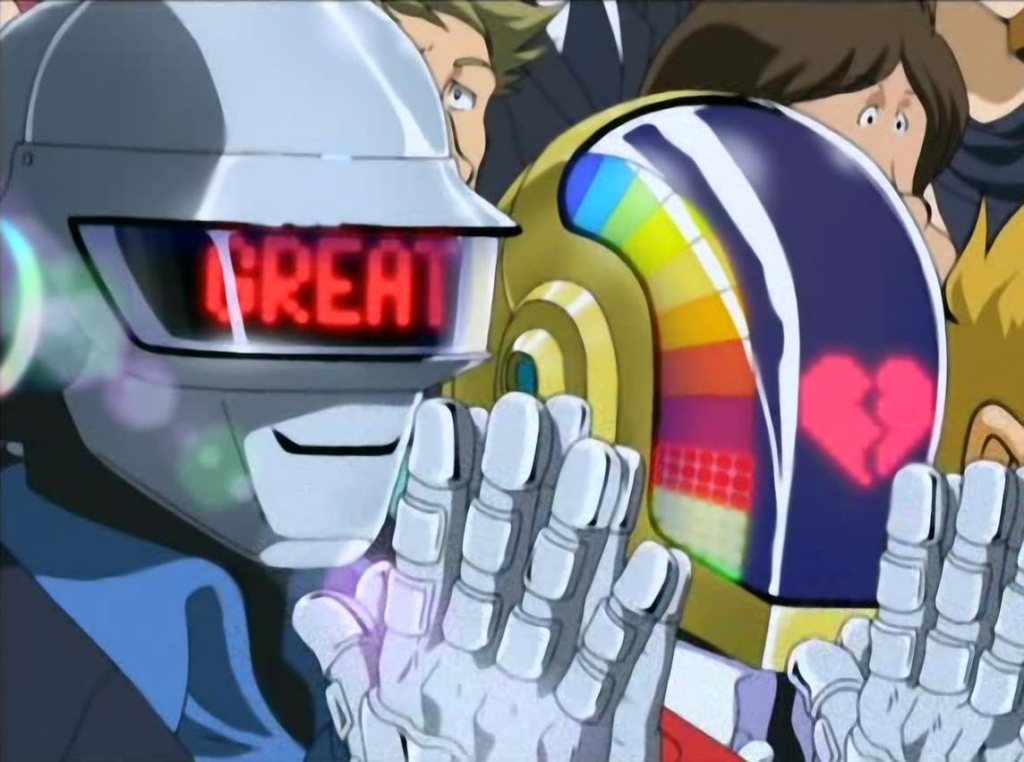
Interstella 5555 tells the story of four alien performers who are abducted and brainwashed into being a musical act on earth. The far out premise upends science fiction tropes about aliens by having humanity being the abductors this time, forcibly removing the band from their home planet, painting their skin in human flesh tones, and replacing their memories with facsimiles set on earth. The mastermind behind this plan is the Earl de Darkwood, an evil music producer who kidnaps alien performers and forces them to play music in a quest for 5,555 golden records, which he plans to use as the catalyst in a dark ritual. Thankfully, an alien astronaut is sent to save the band, and helps them reclaim their memories and identities before he’s tragically gunned down during the rescue. This kind of noble sacrifice feels right at home in Matsumoto’s works, and is a theme in several anime titles he’s worked on. After defeating the Earl, the record company owner calls in a few favors, and humanity takes responsibility for their unethical artist acquisition by pooling their resources together to send the alien band home.
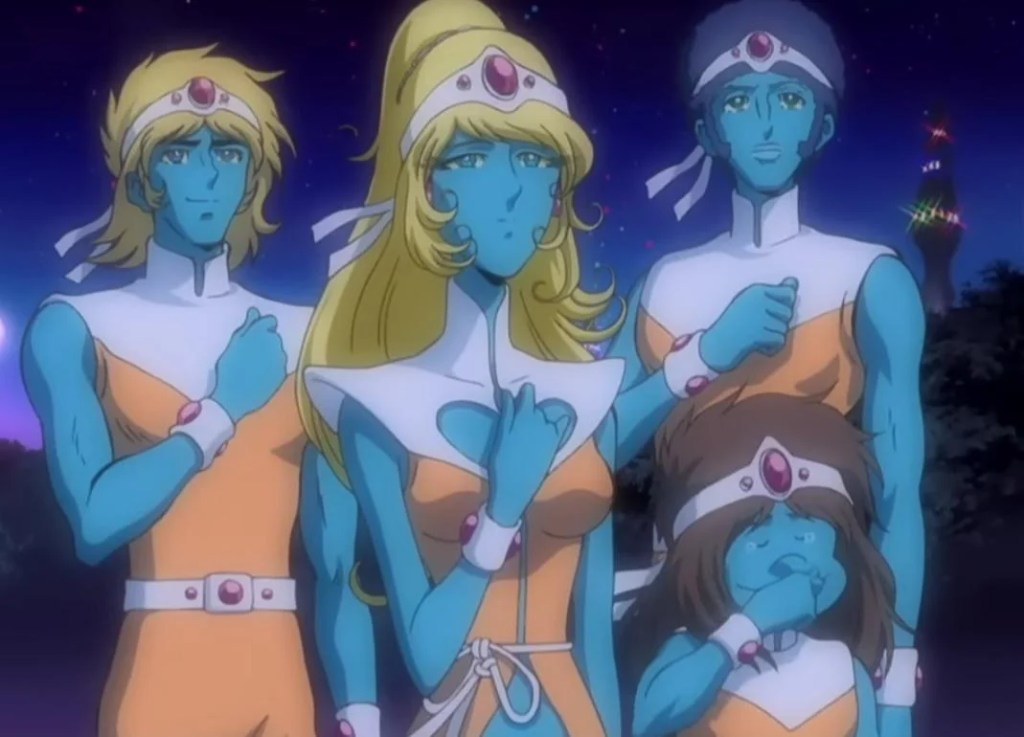
The experience of watching Interstella 5555 is similar to that of watching an anime compilation movie; it feels like an anime series with all the fat trimmed off. Because of the limited scope of the production, the animation is high quality through the entire runtime, although some actions don’t synchronize with the music exactly, evoking a more traditional AMV experience. Discovery, being Daft Punk’s second album, is an excellent backing for the story. Some of the visuals are so iconic and well timed with the music that I’m reminded of the OVA whenever I hear the music in a different context; the opening sound in “Harder Better Faster Stronger” will always be the sound of the descending elevator in the abducting ship to me.
It’s hard to deny how cool it is to see Matsumoto’s character designs set to this music, even if the cast is suffering from a slight case of same face syndrome. Three of the Crescendolls, Stella, Arpegius, and Baryl, are dead ringers for Maetel, Captain Harlock, and Tochiro from Galaxy Express 999. The action moves at a fast pace, and it’s exciting to pick out easter eggs in the background of the hour-long special. More than anything, the music is phenomenal. Early Daft Punk doesn’t have all the polish that they’re known for now; I don’t mean to say that any of the music is bad, but I appreciate that they weren’t all radio songs, and were well suited to animation. My only critique is that some of the animation feels as though it was made without knowing what the accompanying music would be. Why is “One More Time” the theme of the Crescendolls when it only features two of their instruments? It makes me wish that the animators spent a little more time to figure out what instruments would have produced the sounds of Daft Punk’s music rather than going for the more generic rock band aesthetic.
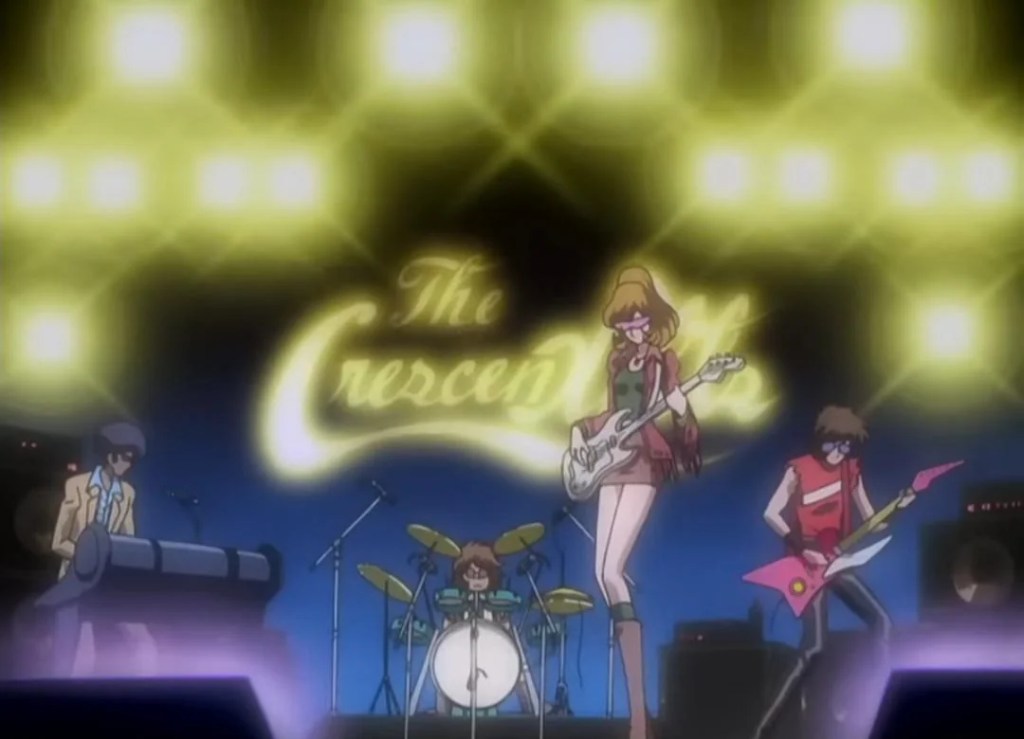
Overall, Interstella 5555 was a stellar OVA to rediscover this week, and I’d recommend it to every Daft Punk fan I know. As an anime, it may feel a little generic, but the groovy, spacey, aesthetic is really energetic and fun. It’s surreal to hear Daft Punk as the soundtrack to an anime, but it reminds me of the cyclical nature of creative inspiration. Matsumoto said he was inspired by French films, and Daft Punk have stated they were influenced by watching Captain Harlock as kids. Interstella 5555 is a reflection of a reflection, and yet even 20 years later it still feels fresh.
 Sam Wolfe is alive