For Movie Club this week I decided to get into the spirit of the season by bringing my favorite Christmas movie to the table. To be frank, there aren’t many holiday films that I enjoy. I’ve never really connected with the ways it’s traditionally depicted in media, but whenever I’m in the mood for a holiday movie this is what I usually put on. It shouldn’t come as a surprise that my favorite Christmas movie comes from Japan, coincidentally, another work by Satoshi Kon. This week we got together to watch the anime classic, Tokyo Godfathers (2003).
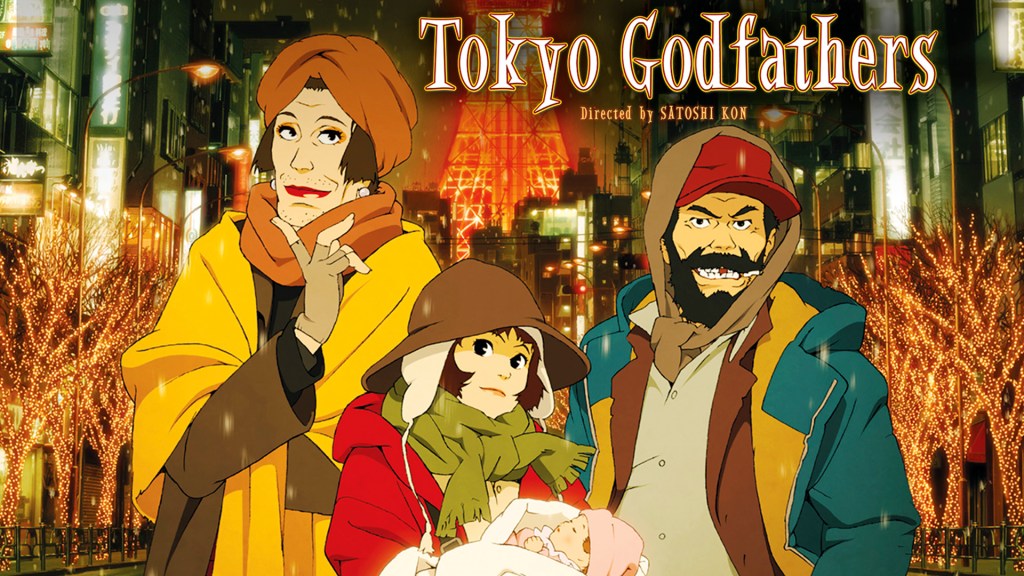
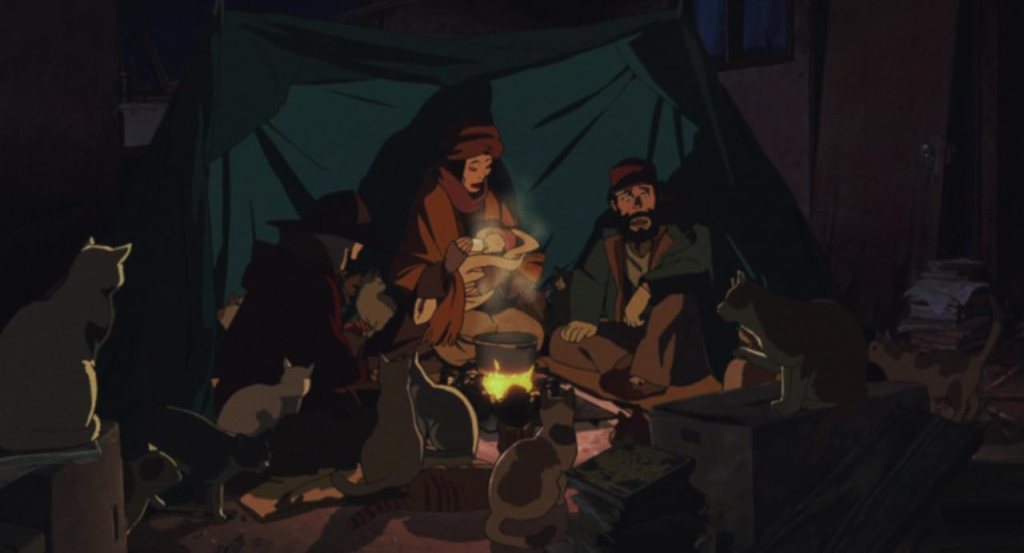
Tokyo Godfathers is a story about three homeless people living in Tokyo, Miyuki, Hana, and Gin, who find an abandoned baby in the trash on Christmas eve. A product of the foster system herself, Hana names the foundling Kikiyo, and begs for help from the other two in reuniting the child with her family, and the three set off on an adventure to return baby Kiyoko to her parents. Along the way, the three interact with an eclectic assortment of communities, including an underworld crime family, a group of gay entertainers, and a neighborhood watch. As the trio traipse through the different social circles, they learn more about each other, and each experience a Christmas miracle of their own.
This has been one of my favorite movies for a long time. Kon brings an interesting outside perspective to the portrayal of Christmas and the reason for the season. While the movie depicts Christmas in Tokyo, the themes have more to do with helping your fellow man and feeling comfort around the holidays than the couples’ holiday I understand Christmas to be celebrated as in Japan. I also have an outsider perspective on Christmas, and Tokyo Godfathers seems to capture everything universal that I understand about the holiday while still maintaining a level of irony and self awareness that can only come from not being overly attached to the material. The visual parody of the three homeless people finding the baby and the three wise men going to Jesus is outrageous in concept, but I think it only works because the parody doesn’t dwell so long that they make an overt biblical comparison. So much of this movie wouldn’t hit the same way if it were an American movie, and I don’t think the characters would have the shade of darkness that they do were it not for Satoshi Kon’s unique storytelling and direction.
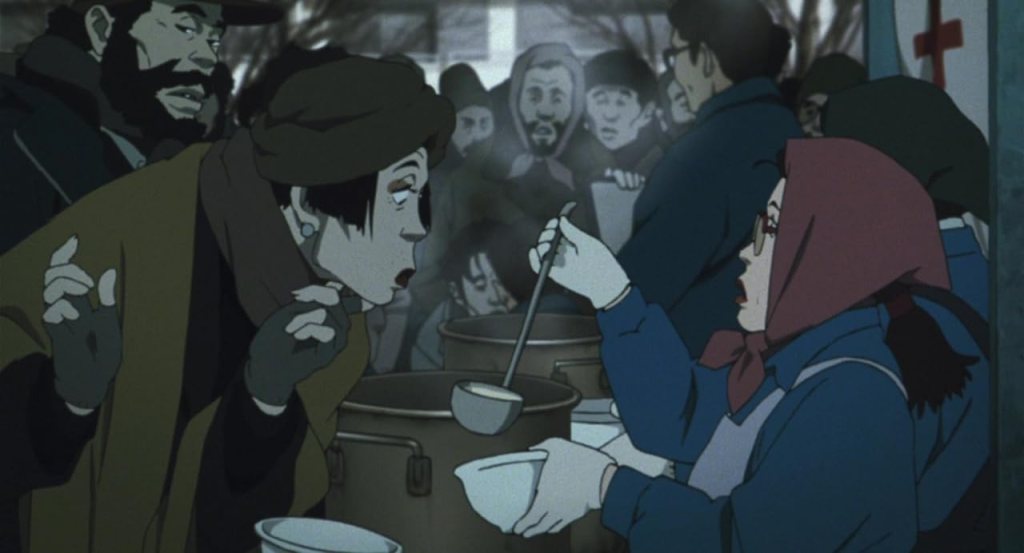
I talked about this when discussing Paprika (2006), but Satoshi Kon has an excellent hand at writing humor that pokes fun at characters without taking away their dignity. Hana has always been a standout character to me, even before I shared an identity with her. There aren’t many stories, especially in animation, that feature an adult trans woman as a central character. The movie does prod at Hana’s gender identity, but only in a way that embraces the reality of the world she exists in; several characters express confusion towards Hana identifying as a woman, but Hana isn’t ever villainized for it. However, I can understand if someone were to find some of the material transphobic; Hana is made fun of for her appearance, and her large feet, but it feels like that comes from a place of showing how the character exists in the world, rather than mocking part of her identity.
Hana is the driving force of most of the action in the story. Her motherly instincts lead her to push the group to find Kikyo’s family, and it’s her actions at the end of the movie that ultimately save the day at the film’s larger than life climax. Hana honestly reminds me a lot of Albert from the 1996 film The Birdcage, another movie in which we’re able to laugh at some of the absurdity of gender without taking away the respect we have for the character. Japan’s treatment of gay culture, particularly in anime, is pretty cruel, but watching the 2020 G-KIDs dub for this screening I was surprised to learn that Hana and her mother were played by queer women in English. This is Shakina Nayfak’s first and only voice role, according to Behind the Voice Actors, but I really appreciated the honest energy I heard in her performance. This is a complicated character to voice, and I thought she made some brave decisions in playing Hana more authentically, rather than trying to deliver a more practiced feminine sound. Hana is funny, she yells until she’s out of breath, and she sometimes acts unladylike, and I really thought Nayfak channeled all of that direction really well.
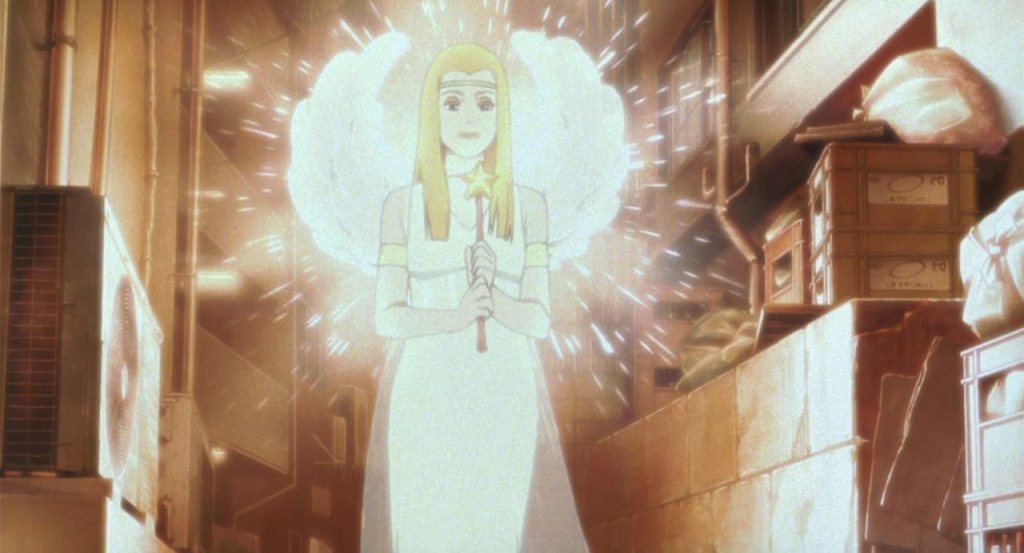
Something I noticed while we were listening to the dub was that they changed the Angel who finds Gin’s voice to be more feminine in English, rather than a voice that implied she was a crossdressing man in Japanese. It doesn’t change much, but it was interesting how that context changed how I interpreted Hana’s mother’s bar from being an overtly gay bar to being more of a party bar. However, despite this change in context, both voice performances work for the scene. So much of this movie is told from specific perspectives, and we’re presented with how different characters perceive the world at different points in the movie. For example, when Gin explains that he is a former cyclist, we see an image conjured in Hana and Miyuki’s heads of what he looked like. That image is then updated when we later learn that he wasn’t a cyclist, but owned a bicycle store. Similarly I think that the Angel’s voice we hear is entirely what Gin is perceiving in that moment. It makes me want to re-watch the movie with an eye for times when characters are being unreliable narrators like that.
Ken’ichi Konishi was the character designer along with Satoshi Kon on this film, and I think a lot of work went into the three protagonists, especially Miyuki, who looks an awful lot like Paprika to me. I appreciate that we see these characters at multiple points in their lives during this movie. Many of us feel reflective at the end of the year, and I think that comes with the territory of a holiday movie. Knowing the different characters’ backstories also makes a rewatch more interesting, as we’re able to pick up on little details like Gin being upset with Hana naming the baby Kiyoko, rather than the naming in general, or the newspaper Miyuki reads displaying the message “Angel is safe.” These details add a lot of depth to the characters, and is part of why I find myself enjoying this movie so much. The film also has some beautiful animation, and having just visited Tokyo myself, I loved seeing all the detailed backgrounds.
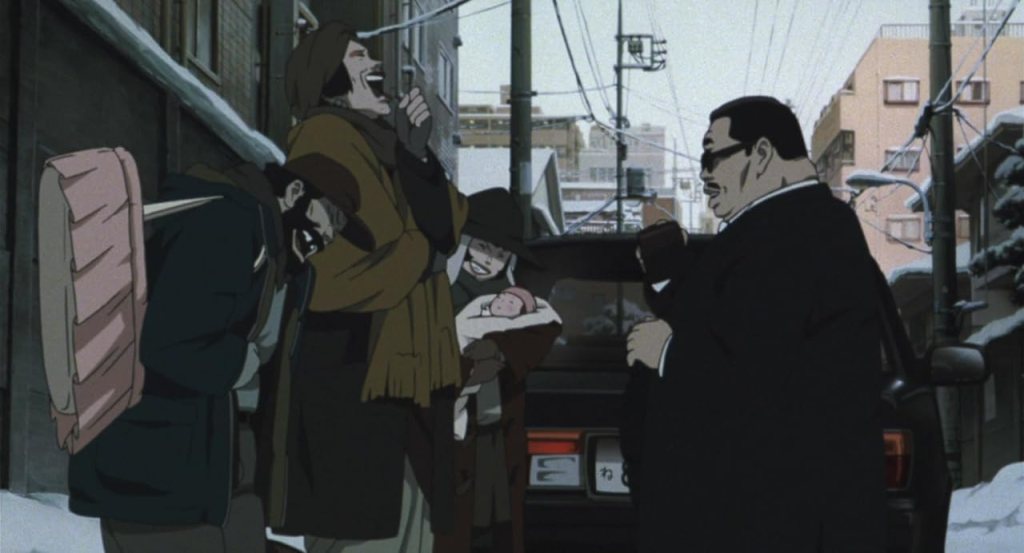
In the past, I’ve had a lot of trouble showing this movie to other westerners; the plot is a little confusing if you aren’t following how the scenes connect. What’s supposed to be a game of following the clues can start to feel somewhat aimless, even knowing that as long as the characters still have the baby, they haven’t completed their goal. I can see myself wanting to pick up a new copy of the movie that includes the dub for that reason alone. As much as I enjoy the original Japanese performances, watching a work in your native language is probably the best way to really understand a foreign movie. Don’t get me wrong, I’m still watching a lot of anime in Japanese, but when a dub comes out, I think it’s worth revisiting.
Ultimately this is a film about found families, and how being with loved ones, even ones we aren’t directly related to can save us from ourselves. It’s really interesting to have three protagonists with such realistic flaws; Miyuki believes she can’t find forgiveness for her overreaction with her family, Gin berates himself because of his gambling addiction, and Hana isolates herself from others throughout the film. However, when they’re together, they’re able to care for each other and neutralize one another’s negativity. It’s unclear at the end of the film whether Miyuki will stay with Gin and Hana, or what will happen to any of them once they leave the hospital, but within this story they demonstrate the miracle of community and togetherness. The abrupt pacing of the ending might throw some audiences off, but to me it feels like the perfect conclusion to this off-beat story.
Revisiting one of my favorite movies with friends was a lot of fun, and seeing it dubbed in English for the first time made it feel like a fresh experience. I only wish that there were subtitles for the Spanish-speaking characters in the movie, but luckily my cohorts were able to translate what I couldn’t pick out. I’d absolutely recommend Tokyo Godfathers as a fantastic holiday movie, and as a positive representation of queer people. I already can’t wait to watch this one again, and considering my affection for the holiday genre, that’s a Christmas miracle.
 Sam Wolfe is alive