Dungeons & Dragons, and in fact tabletop role playing games in general, are the most difficult games to play in the world. I write that with confidence; no other game requires its players to be as collaborative and creative, as anyone coordinating when their playgroup will next meet can tell you. Coordinating schedules and conquering stage fright are bugbears that often make the game unplayable, so it follows that, for decades, people have tried to create virtual representations of the tabletop RPG experience to make the genre more accessible. Dungeon for the PDP-10 was the first of these, and it spawned countless inspirations, such as the Dragon Quest and Final Fantasy game series. However, whenever discussing digital adaptations of the tabletop experience, Baldur’s Gate is a name most virtual dungeon delvers are quick to bring up, and after more than 20 years since the second game in the franchise, Larian Studios has stepped up to the plate to deliver a modern take on the classic.
The following contains minor spoilers for Baldur’s Gate 3
There’s been a lot of buzz on the internet regarding Baldur’s Gate 3. The game has been in an open beta for three or so years, but it officially launched on August 3, 2023. The mission was clear: deliver a rich, branching storyline with intersecting narratives, allowing players a sense of choice and agency similar to what tabletop games afford. In a tabletop setting, your imagination is the primary limit on what your character can do or say; it’s a daunting challenge to bring that level of choice to a video game.
To start, Larian has done a fantastic job on the writing side to pull players into the world of D&D. While many people imagine traditional wizards and knights when thinking of Dungeons & Dragons, Faerûn, the canon setting for official adventures, is an eclectic place, no doubt due to the patchwork nature of releasing supplemental books over 30 years. It’s a bold decision to start the game on a nautiloid ship, an illithid space-faring vessel. The H.R. Giger-esque biomechanical elements of the ship make for a very alien setting to wake up in, and the excitement of being in a chase involving dragons, demons, and your illithid captors filled my sails to be ready for a heart-racing fantasy adventure. The intro cutscenes are quite honestly gorgeous, and are directed with the precision I would hope for a Hollywood adaptation of Baldur’s Gate. I liked how as I found more characters on the ship I saw more of the classic swords and sorcery elements I was more familiar with, almost like my character was waking up from a terrible nightmare. New players however, might be put off by some of the horror elements of the setting.
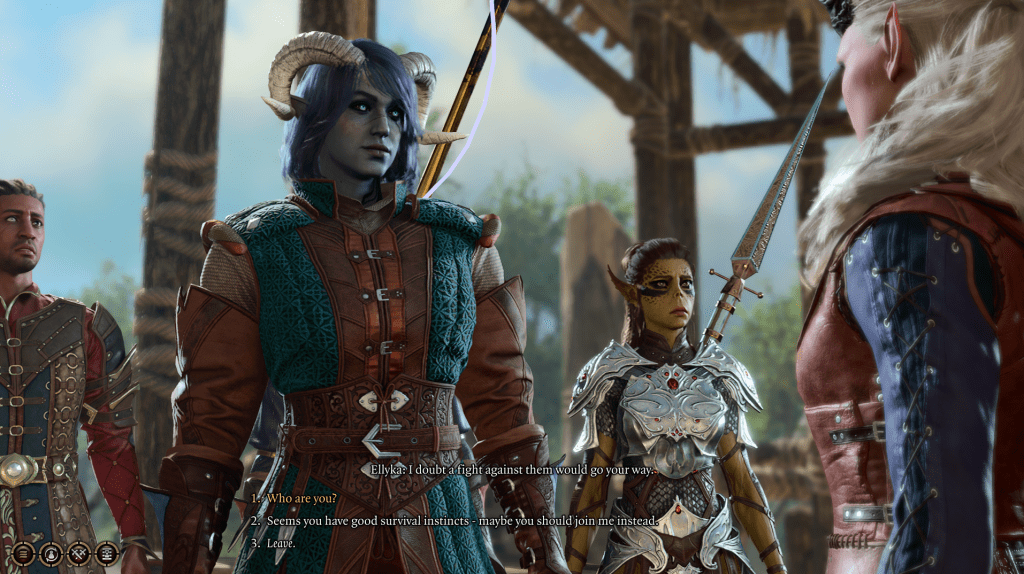
The presentation of this game is just dynamite. Characters are brought to life through beautiful renders and immersive voice performances. The “origin” characters, characters you can either play as or have join your party, are all well written, with interesting wants and needs for players to uncover through their adventure. Each companion has a genuinely interesting story, so much so that I found myself wishing I could have more than four characters in my party. If I’m being honest, I almost wish Baldur’s Gate 3 had limited how many characters it exposed me to in its first few hours. Baldur’s Gate 3 has a bit of a “too much and never enough” problem, where characters will assert their personal missions in one frighteningly high stakes conversation, then refuse to bring them up when you return to talk to them later. In my first playthrough, I tried to roleplay a cool-headed warlock who saw the value in waiting for emotions to calm before making a decision; the result was that most of my companions accosted me with quests of personal urgency, and then never mentioned them again, only to die offscreen from neglect later. I understand that some of the issues around dialogue options were bugs, several of which have already been resolved, but that doesn’t stop the game from having a somewhat jarring conversation system. Dialogue, while well written, sometimes feels stitched together; conversations don’t flow naturally, and it can be frustrating when you want to discuss something with a companion, but the only options presented are to say “wait for me at the camp,” or to walk away wordlessly. Other times, I was unexpectedly presented with the thirstiest lines these adventurers could muster, feeling all at once taken out of the roleplaying experience and a little disarmed. I guess the life of an adventurer is truly a lonely one.
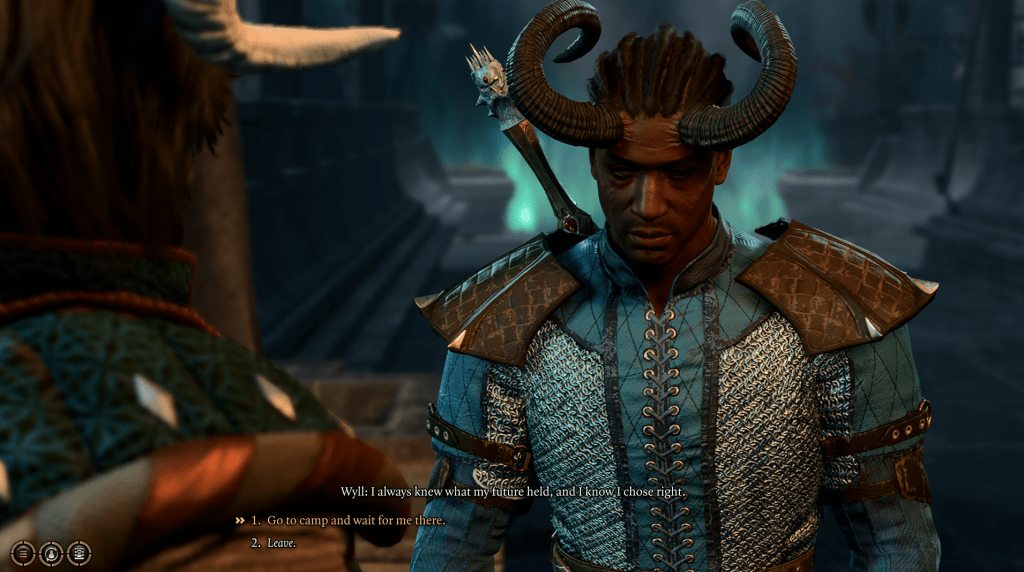
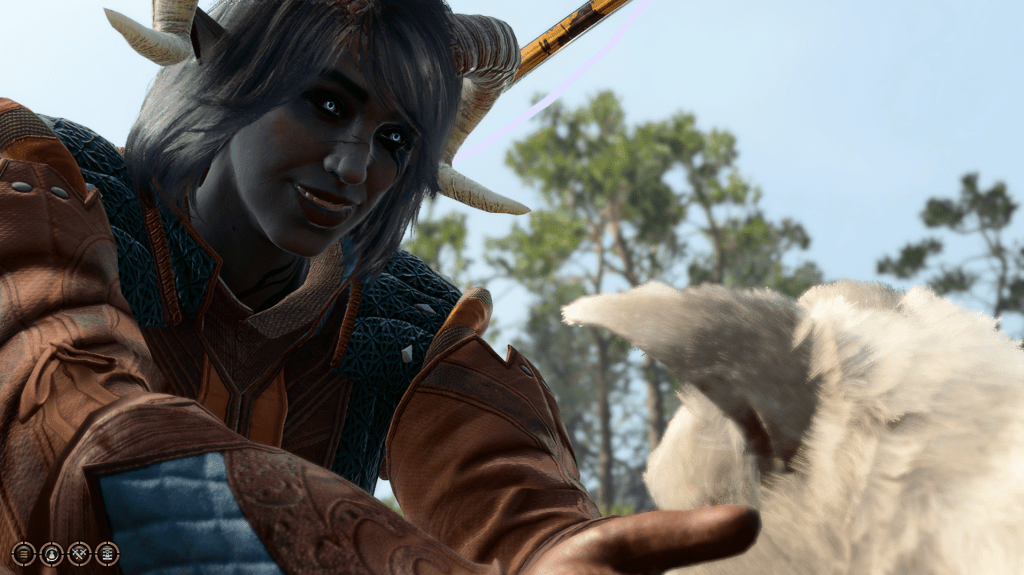
I should stress that its these breaks in immersion are the exceptions to an otherwise captivating experience; seeing the contrast in places where the presentation is otherwise so strong is jarring. While the writers of the game should be lauded for writing dialogue that aligns with almost any path the player chooses, I frequently became frustrated with trying to identify what actions I needed to take to set off certain conversation triggers. Some of the more character specific dialogue options can also be a little underwhelming; many dialogue options present flavor for the sake of the player’s roleplay experience rather than divergent gameplay, which can sometimes make the whole thing have an “all roads lead to Baldur’s Gate” feeling. Other interactions however, made it feel like I was discovering secrets hidden in plain sight; I really enjoyed the dialogue accessed through the Speak with Animals spell, and I really liked how the animals spoke in a different syntax depending on how domesticated they were.
Here is the core issue with Baldur’s Gate 3, and I write this as someone who is familiar with the first two games in the series: while the game does try to present a myriad of ways to interact with the world, the system is simply too arcane to be approachable to modern players. Baldur’s Gate 3 is a loving recreation of the old role playing adventure games it shares a name with, but it’s 2023, and the game would have benefitted from including some accessibility improvements from the last two decades. The UI is fairly robust, giving the players a lot of options, but at times it’s overwhelming, and I found myself wishing for a more basic hotbar rather than the sliding unilluminated runes I had to parse. A misclick shouldn’t be the difference between you swinging your sword at the enemy with a percentage chance to hit, and you swinging your sword with no target, guaranteeing a wasted action. The game is ponderously large on purpose, you aren’t supposed to see it all in one playthrough, but the resulting gameplay that comes from this decision makes it way too easy to miss story beats, quest hints, and rare items, and this is especially frustrating when you’re hoping to tackle problems a certain way, or if an option isn’t highlighted in your adventure because of the path you chose to take. I was more than halfway done with Act 2 when I learned there was a location at the northern tip of the map that housed characters whose goals aligned with mine, but I approached the map from the south, and a curse in the area discouraged me from exploring; it made me feel like I was being punished for doing what the game was telling me to do and not meticulously doubling back to check for alternate routes. To that end, Baldur’s Gate 3 is full of riddles and secrets that I’m certain most players won’t even encounter; there are items meant to be combined, hidden caches activated by inserting runestones into sockets, you can even forge your own armor from legendary ore, sometimes only after examining an item in your inventory, but the game never instructs you on how to do any of this. The tutorial messages that are offered disappear too quickly to read them, and in a game with this many systems and keybinds, I’m not embarrassed to say I don’t know how to make them appear again.
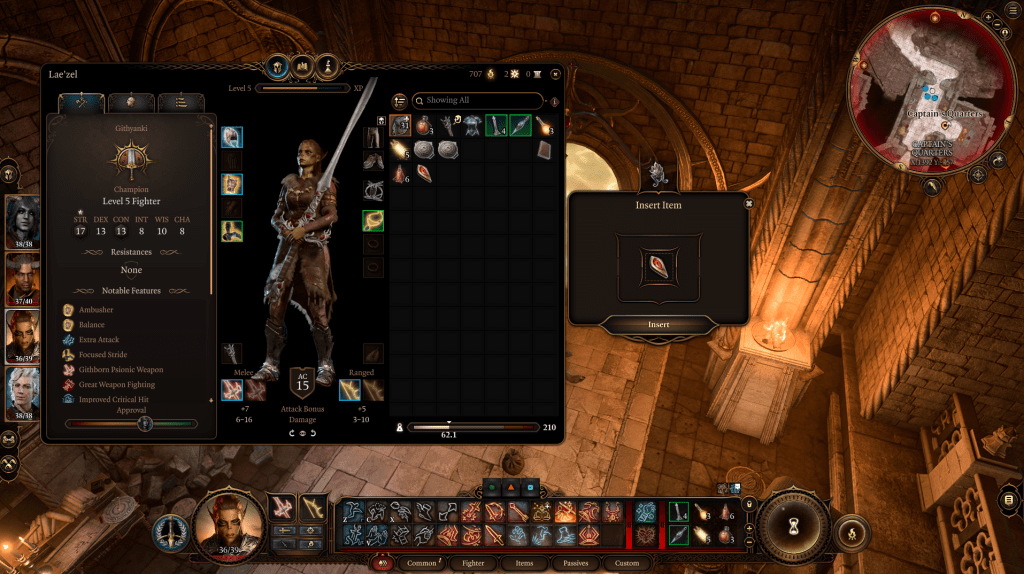
It’s really unfortunate, because I can tell a lot of thought was put into designing these puzzles, but by the end of my first character’s run (a playthrough I didn’t finish), I was frustrated and annoyed with them, and I started using guides online to find what I was looking for. My bags were stuffed with letters and trinkets, dead ends from Act 1 quests I hadn’t completed or didn’t notice the environmental clues for; without realizing it, I filled my pockets with junk, and I had to spend an entire play session organizing my inventory. In a way, it felt like playing with the least helpful GM possible. That complexity is in service of adding depth to the game, but without a proper introduction, players are left to experiment on their own, to mixed success. In one play session, Shadowheart was unwittingly arrested when I accidentally clicked on a book that I meant to read, stealing it instead, and I had no concept of how to free her or get her back without incriminating my entire party. Frequently rocky pathways in the mountains and caverns will require you to use a jump action, which just breaks some companion’s pathing. I can’t tell you how many times I’ve started a fight only to notice the casters didn’t make it because they’re on the other side of a chasm and need me to assume direct control for them to make the jump. This issue only becomes more frequent later on, as some areas seem to only be accessible with special jump actions, or the Fly spell. This is by far the most difficult element of tabletop RPGs for Baldur’s Gate 3 to emulate: the openness of exploration in a roleplaying game. While I ended up rage-quitting a few times, I admire Larian’s ambition, despite my frustrations.
Combat, however, is where Baldur’s Gate 3 excels. I was very impressed with the game’s ability to handle so many combatants at once, and add fighters to an ongoing skirmish. Spells and hits feel very good, and by level 5 almost every class is competent at something, although at early levels some martial classes have trouble keeping up with the casters. Sub-optimized characters are easily eclipsed by more focused builds, which is a shame because I was so excited to hear that they included a multiclassing feature in the game. While this is great to get a sense of how a multiclassed character might play, I myself built a level 3 warlock/level 3 sorcerer, you miss out on a lot of the cheese that tabletop play can afford you (sorry, coffeelocks don’t work here!). I was playtesting a pact of the chain warlock I intend to play in a future campaign, but was very disappointed to find I couldn’t speak to my imp familiar. Familiars can’t even interact with the world outside of attacking, which led to another break in the immersion for me: why can’t my imp pick something small up and carry it back to me? It has a strength stat. (It could pick something up in a tabletop setting!)
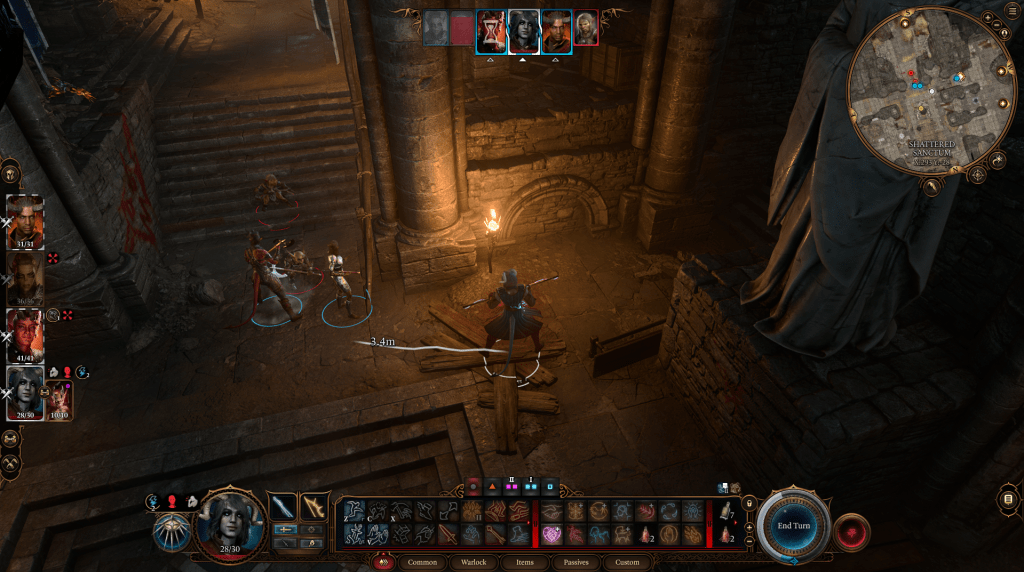
I should also note, it’s great that Larian made it so easy to change classes and reassign your feats (assuming you don’t miss the early quest area). It doesn’t really feel like there’s enough room for more than one of each class in your party; I ran with two warlocks, with Wyll as a pact of the blade ‘lock to distinguish from my chain, and it didn’t ever feel like Wyll had much to do. Playing through as a druid felt much more organic because I was much deeper into the story when I found another character who’s class overlapped with mine, and there are some classes that only the player character can be. (There’s also more for a druid to do in combat, between healing, tanking and finding weird ways to dish out damage like combining Thorn Whip with Spike Growth.)
The biggest strength of the game is in its roleplaying tools. I was impressed that I was able to recreate my druid character from my current D&D campaign in a way that felt true to her. The use of backgrounds and inspiration to define your character really stands out, and the character editor feels fully featured and allows for a lot of customization. Intimacies never came up in my playthroughs, but I felt something knowing that the characters I put into the game were physically like me. It’s a small inclusion, but it meant a whole lot, and I didn’t see too many people clowning on the game for being able to select one’s genitals.
Whatever complaints I may have had with the game’s technical side, they were more than made up for with the story, and aided by the roleplaying tools. I think that’s honestly why I find Baldur’s Gate 3 so frustrating. The story is great, the roleplaying is fantastic, the simulation is realized, but the interface just drives me up a wall. It’s unclear when taking a long rest actually moves time forward chronologically, and hard to tell which “urgent” missions actually require urgency. There are too many hidden systems, too many secrets, and the world is just so darn fatal, one misstep could spell the death of a character, and hours of gameplay lost, depending on when you last saved. My solution was to become intimately familiar with the quick save (F5) and quick load (F8) keys.
Overall, I think Larian did a fantastic job in trying to create a computer-run tabletop RPG experience. Baldur’s Gate 3 is an impressive feat of writing, especially with how many intersecting plotlines there are. Player decisions feel like they matter, even if the player isn’t always fully aware of what decisions they’re making in a given moment. The character performances are brilliant, and I especially think the lines read by the narrator give a great sense of what playing with a GM feels like. There’s even a multiplayer co-op element to this game I haven’t had time to explore yet. Honestly, Baldur’s Gate 3 would be a great introduction to tabletop games were it not for its archaic interface. Its shortcomings, perhaps in contrast with Baldur’s Gate 3’s better aspects, really serve to demonstrate that while we’ve come a long way in translating Dungeons & Dragons to a video game, we still haven’t quite bottled that lightning yet. The good news is Larian seems committed to supporting Baldur’s Gate 3 and responding to community feedback. However, even without resolving the issues I had with it, Baldur’s Gate 3 is still an impressive roleplaying game filled with loveable characters and memorable questlines.
 Sam Wolfe is alive