A truffle hunter in rural Oregon is forced to return to the city in search of his kidnapped foraging pig. When we heard that Nick Cage was in the starring role, that premise inspired images of revenge and action, like something more in the vein of John Wick. That isn’t what we got, but the soulful story that was delivered was way more than I was expecting. With great performances by Cage and Alex Wolff, and a spoonful of expressive cinematography, the movie caught me off guard with its noir-like themes and heartful narrative. Read on to see my thoughts on Pig (2021).

The following contains spoilers for Pig (2021)
Fairly early on, status is introduced as a theme that the writers are highlighting as important to the movie. When Rob (Nicolas Cage) asks Amir (Alex Wolff) to take him into the city, Amir explains that his job is “all about my reputation.” Amir expresses embarrassment speaking to his contacts with Rob, his disheveled and unkempt appearance contrasting with Amir’s high end luxury brand and aesthetic. Amir, and in fact everyone other than Rob, is preoccupied with status and popularity as a measurement of success. The movie’s opinion of that ethos is made plain by Rob’s verbal undressing of head chef Derek. Rob questions why Derek didn’t make the pub he always talked about as a prep cook, to which Derek responds that people like his restaurant, and that he is popular. Rob’s reply is the thesis of the film:
“…Why do you care about these people? They don’t care about you, none of them. They don’t even know you because you haven’t shown them. Every day you’ll wake up and there’ll be less of you. You live your life for them and they don’t even see you. You don’t even see yourself. We don’t get a lot of things to really care about.”
To Rob, time spent not pursuing what you love is time wasted, in spite of any material success. Derek’s desire to be wanted has all but eroded his unique flavor of food, and it’s pitiable. Derek is presented to be very much on the back foot through the entire conversation, and it’s clear from his reaction that some of his passion for cooking has died in becoming a successful restaurateur; the name of his restaurant is Eurydice.

Rob embodies the idea that exquisite art transcends social hierarchy. On a classical music station Amir listens to, the DJ states “…where classical music proves superior to all other forms is in its staying power. It was beautiful 200 years ago, and will remain beautiful 200 years from now.” While Rob may not agree with him about music, his artful cooking navigates social conflict the same way; delicious food speaks for itself. Despite becoming a recluse, the memory of his cooking casts a long shadow over Portland, and is enough to encourage Amir to reach out to him despite his misanthropy.
It’s also Rob and Amir’s combined cooking skill that softens the heart of Darius, Amir’s father and competitor. Darius is unsupportive of his son’s business to the point of being a direct competitor to him, but he admits to the kidnapping and mishandling of Rob’s pig because he’s so moved by the meal evoking the last happy memory Amir has of eating as a family together. This isn’t a talent unique to Rob, when he visits his former baker, he’s affected by the quality of her baguettes. The movie argues that when life throws up a wall, the answer is to be undeniable in your craft.

The movie has an elegant visual presentation overall, although I found there to be one too many musical montages. Cinematographer Patrick Scola does a good job of expressing how clear and quiet the forest is to Rob compared to the blur of the busy city. I very much got the sense that returning to the city was disorienting for Rob, especially compared to the still aerial shots of the woods. Some of the cooking segments felt cheesy, but it’s hard not to evoke Ratatouille (2007) comparisons when a character being emotionally devastated by food is the climax of the story.
Nicolas Cage had to be cast in this role as a misdirect; his brand would suggest a more bombastic, violent version of this movie, but he really showcases some of his acting chops here. This is an emotional role for Cage, and while his character is cooler than the other side of the pillow, he isn’t glamorous. Alex Wolff plays well against Cage acting as his straight man, but he also has some strong moments of tension, and he does a good job embodying a character with such a complex relationship to Cage’s. Brandy the pig and Cora, her understudy, were also adorable, despite not being on camera for long.
Pig (2021) was written and directed by Michael Sarnoski, and it’s a bit of a breakout film for him. Overall, I was impressed with the scope of the movie, and satisfied with the runtime; it’s always good when a movie doesn’t go on too long, and I didn’t get bored watching this one. Sarnoski has previous experience on shorts and TV episodes, but this is his first feature length film, and it’s a pretty solid outing. The movie has a style in its low-saturated color palette and heavy shadows, but I would have trouble identifying Sarnoski’s hallmarks as a director if asked. I’d love to see another film from him that further develops his style and unique voice.
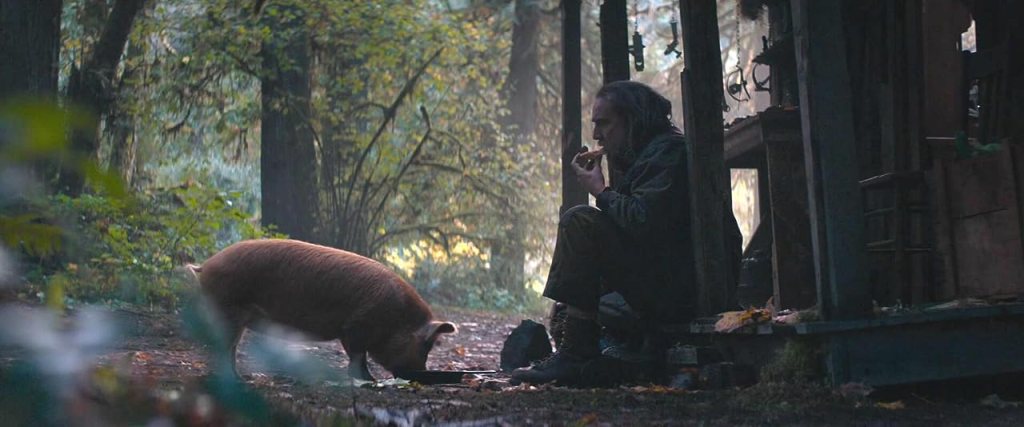
Overall, Pig (2021) surprised me with how genuine and personal the story turned out to be. I think the film intentionally tries to disarm the audience by placing Cage in the lead role. One is never certain of what to expect from a Nick Cage performance, and Rob’s enigmatic character is a perfect fit for Cage’s range. The ultimate story is a little sappy, but it has a very mature message: the characters at the end of the story are broken, Amir’s relationship with his father is still strained, and Rob’s pig is dead, but they resolve to continue their working relationship and face the next day. Lovers of evocative, empathetic film-making will enjoy Pig (2021), but it’s perhaps better to go in knowing as little as possible, and let the movie carry you away.
—
Slightly different format for Movie Club this time; I’m trying to get away from summarizing the entire plot of a film, as that can take up so much of a review and not leave much time for reflection. Let me know if you prefer the old style and I’ll reconsider how much of a film’s story to report in future movie reviews.
– S
 Sam Wolfe is alive