In the months leading up to its release, if you’d asked me if I was interested in the upcoming ninth generation of Pokémon games, I would have told you I had aged out. Catching and battling the collectable monsters is a core nostalgic memory for me, but the prospect of a new slate of creatures had lost its novelty; I’ve played some of every generation, but the previous two, ‘Sword and Shield’ and ‘Sun and Moon’ were starting to make me think that the games just weren’t for me anymore. And that was okay! I have a few friends who are Pokémon lifestyle enthusiasts; they buy merchandise and wear clothes, but don’t really have time for the games anymore. Maybe that’s how my fandom would express itself?
Despite those feelings, when a friend of mine picked it up and was looking for a rival, I couldn’t help but find myself downloading a copy of Pokémon Scarlet off the Nintendo eShop. Having someone to play with is a pretty strong motivation for me, but still, I wasn’t sure that I would even finish the game–it had been a few generations since I had gotten all the badges. Since then, I have accrued a total playtime of 240 hours. While far from a perfect game, Pokémon Scarlet manages to be one of the most ambitious steps forward the main line Pokémon series has taken since first entering the polygonal world and leaving humble sprites behind in Pokémon X and Y. Read on to see my thoughts on the latest challenge to catch them all!
The following contains spoilers for Pokémon Scarlet
If there’s any word that best describes the 9th generation, it’s ambitious. Until now, Pokémon games have been a largely linear experience; fan games have played with level scaling to allow for more openness, but the official games have always been a directed experience, usually eight badges in a set order, with an Elite Four to topple at the end, securing your place as a Pokémon Master. Scarlet’s open world design is evident in the Paldea region map, an uninspired, geographical anomaly of a donut, complete with a jelly filling to be unlocked once the three branches of main quest have been completed… but I’m getting ahead of myself.
Main game
The game opens with a tutorial that lasts about an hour and a half; a leisurely stroll with Fuecoco, Sprigatito, and Quaxly, the three poster-mon of this generation, and some painstaking introductions to all the characters we’ll get to know as we spend time in this world. Strangely, it feels like this game spends less time on the mechanics of how to catch a Pokémon, and far more on introducing classmates and teachers. After being introduced to the three characters who represent the three primary objectives of the game, Nemona, Arven and Cassiopia, the latter of which communicates with you through text messages sent to your ghost-possessed phone, the great treasure hunt begins, and you are allowed to explore the world, carte blanche.
You are encouraged to go back to school, where you can connect with faculty in what feels like a soft attempt at capturing some of the social school days of the Persona series, but I’ll tell you right now, it doesn’t really hit. The teachers aren’t terribly interesting, and for all the tedium of watching all of their classroom cutscenes, you’ll get a notification that they like you, and maybe a couple items. I’ll remind you that going to school is weighed against exploring the world, catching and training new Pokémon. It’s slow, it’s clunky, and it doesn’t really end up being the hub I think they hoped it would be. For all my time spent in school, I was only happy to learn about the four legendary Pokémon from the history teacher.

Once the world opens up to you, to the game’s credit, it really is an open world. Seemingly nothing prevents you from walking towards any objective that looks interesting on the map, except for the local Pokémon, which generally don’t give an indication of how strong they are until you’ve begun a battle with them. The map is populated with objective markers representing gym leaders with badges to collect, titan Pokémon guarding mysterious herbs, and Team Star bosses to defeat. These objectives can be tackled in any order, but they don’t scale with the player’s number of badges, or Pokémon’s levels, so you can pretty easily find yourself overwhelmed and in a high level area. I think the intention was that players would essentially choose how difficult they want their experience to be, to a point. Maneuverability on your provided dinosaur-bicycle is locked behind how many titan Pokémon you’ve defeated, so I made tracking them down my first priority, and in doing so I wandered into some areas where wild Pokémon were sometimes 16 levels higher than mine. As a seasoned trainer, this was exciting to me–I know abilities, I know held items, and most importantly, I know how Super Fang works– but I couldn’t help but feel that a newer player could easily get overwhelmed and lost at how directionless the game feels. In presenting all the options at once, there isn’t much that unfolds by way of unlocking new areas, or directing your attention across the map. New players will probably want to look up what order they should tackle objectives in, or else risk wandering aimlessly in fields of vastly overpowered Pokémon. Strangely, the route that would only curve up in difficulty doesn’t follow the natural shape of the continent, making it very hard for players to accidentally stumble into an area that is suited for them.

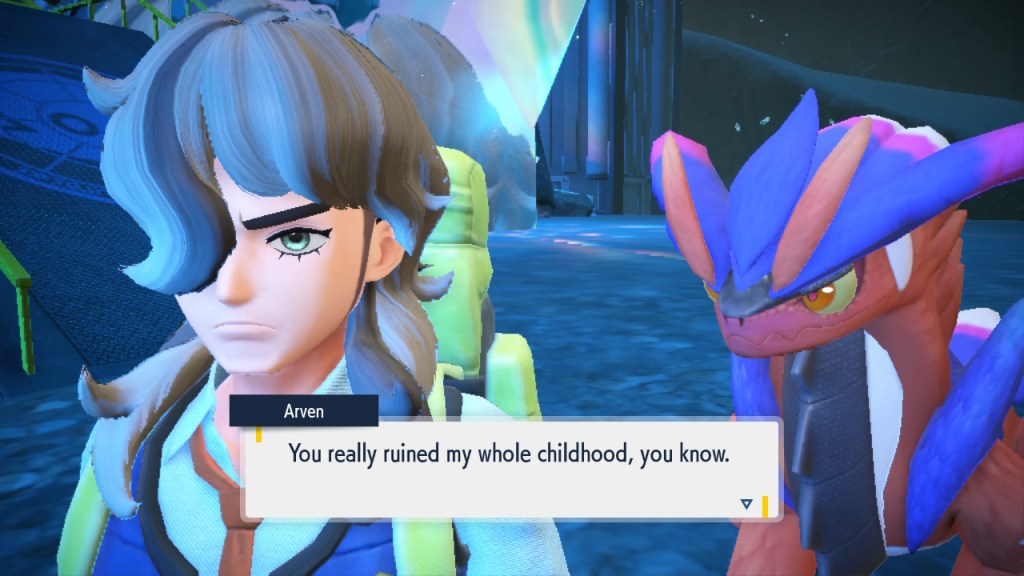
The 6 titan Pokémon are two phase bosses that see you battling alongside Arven, the resident sad lad of this game, on a quest for the perfect sandwich. I am exactly the kind of player Arven was created for, and was quickly charmed by his sad demeanor and his hair covering one eye. As I worked to unlock dashing, gliding and swimming, Arven revealed how he quested to find medicine for his sick dog Pokémon. It’s like the most wholesome motivation they could have given him, and I was there for it. Arven’s story briefly touches on his feelings of being neglected by his parent figure (Professor Sada and Professor Turo in Scarlet and Violet respectively), and living in the shadow of such an esteemed scientist, but in typical Pokémon fashion it’s played pretty safely. The battles are an exciting showcase of some of the new Pokémon of this generation (shoutouts to Orthworm), but because type advantages and weaknesses still come into play, the only challenge they presented was through sheer level disparity. I found myself wishing there were more than 6 titan Pokémon, or that they might have been a little more dynamic in their presentation. During battles I was reminded of the Noble Pokémon in Pokémon Legends: Arceus, but felt that the titans didn’t have nearly as much presence as those boss Pokémon.

The unlocked mobility does a lot for the dino-bike. Koraidon, sorry, I’ll call it by its name, but it’s a dinosaur bicycle. Initially Koraidon isn’t a very impressive mount, lacking a dash and with a weak jump, I was pretty disappointed with the early offering. I’m happy to say that once the later movement options are unlocked, like gliding and swimming, Koraidon starts to feel a lot better, but they really make you work for it. I suspect Koraidon’s final movement was the original concept, and it was pruned back to add something to unlock that allows the player to explore without deliberately blocking off parts of the world, but the resulting basic movement in the early game is really disappointing.
As with previous generations, the Pokémon League is back with a new gym challenge. The trainers have gotten a lot of love this generation; gym leaders, instructors, and notable characters sport sleek, fluid animations to go with their stylish designs, with particular standouts being Larry the dead-eyed salaryman and Grusha, the cool as ice pretty boy. Again, these gym leaders are presented with no correct order, and the only way to learn how tough they are is by challenging them. For me, this translated to some gym leader battles being a nail-biting thrill ride, and others being an absolute pubstomp. I felt a satisfaction that mainline Pokémon games have never been able to previously provide defeating gym leaders with Pokémon 7 to 10 levels higher than my own, and without needing to impose my own Nuzlocke challenge. The new Terastallization mechanic adds a new dimension to battles by granting the ability to change a Pokémon’s typing, and I was happy to be surprised by it in my first few battles. Once you know it’s coming, the trick starts to get old, but as a fresh experience, battling familiar Pokémon that change their strengths and weaknesses was an exciting puzzle, and it presents an exciting prospect in PVP. Conversely, in the back half of my gym circuit I battled Pokémon well below my team’s strength, and could barely be called a challenge.

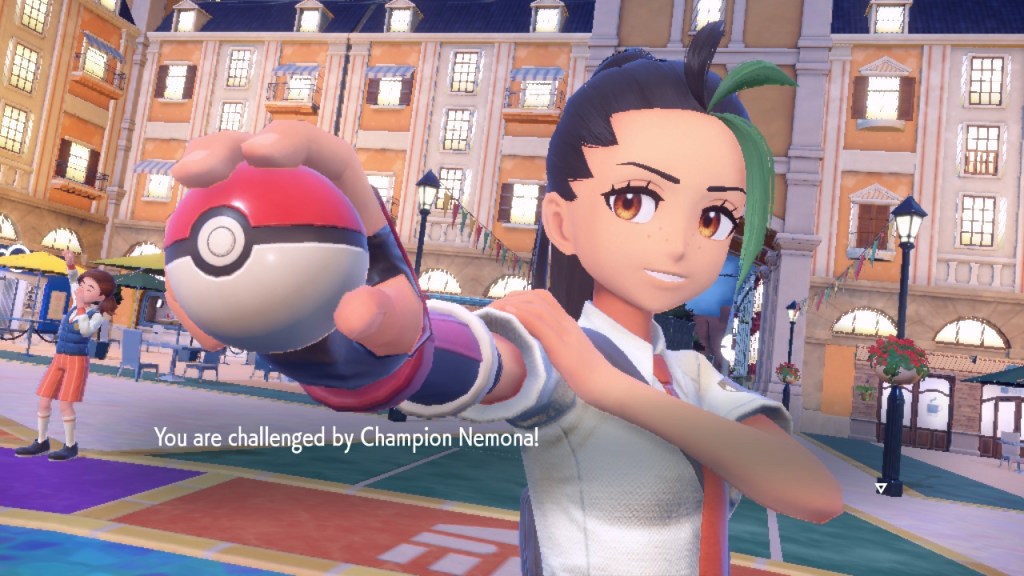
Alongside the gym challenge is your plucky rival Nemona, one of the current champions who hopes to mold you into a worthy opponent by spurring you on to beat the Pokémon League. With recent generations opting for your rival to be a happy-go-lucky, less experienced trainer than the player, I was surprised to see the game embrace this more competitive character. The first two games saw Blue and Silver who were toxically competitive, but since then very few rivals have managed to set a fire in my heart. Nemona didn’t exactly succeed in that, but her tough, competitive demeanor was a welcome addition. What was not so welcome, was the Pokémon League’s screening test. If one wants to “get on Nemona’s level,” they basically have to pass a job interview where answers to subjective questions like “why do you want to be a champion?” have correct answers. I took the interview three times, answering honestly on the first round, what I thought they wanted to hear on the second, and finally, having to use a guide to progress the game. A cute idea with a poor execution.
Unlike the gym leaders, Paldea’s elite four are pretty uninspiring. The game attempts to endear you to them by introducing them to you through your adventures, but between the actual baby and my aging art teacher, they didn’t really have striking themes or aesthetics. Maybe most disappointing, there aren’t even four of them: Larry the gym leader returns as one of the trainers, and as happy as I was to see his overworked David Lynch expression, I couldn’t help but want something more.

The third main objective is “Operation Starfall,” a mission in which players are tasked with disbanding a team of bullied youths who are causing problems for your school. In these sections players utilize the overworld autobattle feature to knock out waves of grunts as they make their way to the Team Star leaders. In concept, this is a great way of making the player feel powerful. Previous games featured unrelenting stretches where players would battle identical goons to get to the end of a dungeon, but Scarlet makes the grunts actually feel like grunts. Unfortunately, autobattling weaker Pokémon isn’t fun. It ends up feeling like busy-work to run around and find smaller Pokémon for my Ceruledge to cleave in half, and even when I do, the animations take just long enough that it feels tedious. Storming the bases is presented as a search to find the leader, but that isn’t really the case; once enough grunt Pokémon have been knocked out, the leader appears on a garish Pokémon-car that’s been dressed up in their respective colors.

I love the concept here, but the story I think is what ultimately undoes the feature. From fairly early on it becomes apparent that Team Star isn’t a criminal organization bent on using Pokémon to take over the world, it’s a bunch of bullied misfits who banded together because they were falling between the cracks. Upon defeat, each leader tells you their saccharine sob story about how their friends are their treasures, and they were just looking out for them. It certainly didn’t make me want to go beat them, which is maybe why I left the task for last. Learning that everyone involved in this conflict is basically a good person, save for the off-screen bullies who made Team Star necessary in the first place, cheapens the entire storyline. Many of these scenes felt like fanfiction for an anime that doesn’t exist, moving through recognizable high school anime tropes without spending any time with the characters. When Penny revealed her true identity by the end, I did not care, which was shocking because I love her character design, and that’s like 60% of what these characters are to begin with.

Upon finishing the three main quests, Paldea’s hidden Area Zero is unlocked. Area Zero is the research site of your game’s respective Professor, who has created a time machine and is bringing paradox Pokémon from either the future or the past to the present. This zone does not feel good to be in; the screen stuttering and lighting glitches make me worry that my game is going to crash every time I enter, and this is where the new paradox Pokémon are found, so it’s a pretty important place in the game. As you explore deeper into Area Zero, it’s apparent that something has gone wrong with the Professor’s experiments, and leads to the revelation that the Professor you thought you had been speaking to this entire time is actually a robotic facsimile, and that the real Professor died protecting your dinosaur bike from a bigger and meaner dinosaur bike. Korraidon, sorry. That robot then tells you that the temporal gateway between times needs to be closed, but that their programming will force them to attack you if you attempt to shut it off. The effect is that the character who exposition-dumps all this information on you will abruptly become the final antagonist–visually it’s very cool, but it’s confusing, very high concept, and my poor little Switch was begging for mercy by the end of our fight in the glowing crystal room.

Post-game content
So what can you do after you beat the game? Well, not challenge the Elite Four again, that’s for sure. As a champion, the Pokémon League’s doors are closed to you, but you do get to take another tour around Paldea challenging the gym leaders to a rematch as a way of assessing their strength, which was a bit of fun. These fights felt like they added a lot to the gym leader’s personas. It was in this second fight that I really fell for Grusha’s sad ice boy shtick. Defeating them all results in unlocking a school tournament, which acts as a revolving Elite Four-esque experience, but there isn’t as much variety as one might expect. I did the tournament 5 times, and each time the final round was with the same competitor.
Completing the game also introduces Tera Raid Battles, the PvE online challenges of this game. Tera Raids have a lot in common with the raids of Sword and Shield, but make use of the Tera typing mechanic to create unique and challenging combinations. These battles are interesting, but I experienced connection and latency issues most times I tried to play online. The real-time element of the battles translates into what feels like multiple skipped turns, broken animations, and glitchy game text. It can be frustrating, and even when playing with someone over a Discord call, we noted multiple instances of what looked like our games desyncing. These raids are how Nintendo seems to be distributing most of the event Pokémon for these games, so it’s a shame that the higher level Tera Raids are gated behind a hidden quest to do 20 5-star raids. More frustrating to me, the game deliberately tells you not to attempt the higher level raids once you’ve unlocked them–I know they’re being cute because these Pokémon are “dangerous” but in a game that’s already this confusing, what’s the sense in misdirecting players to save the lore?

The game is chock-full of extra features, like a camera and gestures for your trainer character. Although your clothes aren’t terribly customizable, your trainer’s face and hair very much are. The picnic feature lets you play and bathe your Pokémon, a nice way to spend time with them, maybe more realized than the campgrounds of previous installments. All these features are welcome, but feel a mile wide and an inch deep.
Catching them all has never been an easier task to complete, thanks to the Surprise Trade function. I was surprised how easily I was able to get all three starter Pokémon, as well as several Violet exclusives, just by chance. As far as designs go, the Pokémon of gen 9 have a lot to offer. I think regional variants are a great way to breathe new life into an old line of Pokémon, and several of the new breeds like Tatsugiri and Paldean Tauros have variations within the species that make them both more interesting competitively, and more collectable. With the help of my real life rival, I was able to fill out my Pokédex pretty easily, 400 in all, and was rewarded with a Shiny Charm for my efforts.

Shiny hunting feels like its own bullet point for this generation. I had heard that the rates for shiny Pokémon appearances had changed this generation, and wanted to test it for myself, so with only one badge to my name I started breeding for a shiny Charcadet. I have become somewhat of a laughing stock in some of my circles for spending literal days in Pokémon Y trying to breed a shiny Froakie, and with some gentle ribbing I think all my friends were expecting a repeat performance. After 591 eggs, even without the shiny charm, I had some good luck. (I named her Kaiba; it’s a Yu-Gi-Oh! reference and a Kaiba reference.)
These better odds are multiplied however, when you remember that Pokémon are visible in the overworld, and often appear in groups. Previously, and when hatching eggs, you had to check whether a Pokémon was shiny one at a time, but with all these additional spawns finding a shiny Pokémon, almost any shiny Pokémon, has become a lot easier. Not only was I able to catch a shiny version of every Pokémon I wanted, I even started a box for the extra shiny Pokémon I stumbled across while I wasn’t even looking for them. This doesn’t make shiny Pokémon feel any less rare; it will still feel like a grind looking for a specific ‘mon, but making them more accessible to everyone feels like it’s only a good thing, rewarding players for their time with a cosmetically differently colored Pokémon.

Breeding also helped me realize that many of the old tricks that were used for min-maxing Pokémon stats, while still functional, have been outmoded by what I think is probably the most welcome change to the Pokémon series: players have nearly full control over a Pokémon’s stats now. Natures can be changed with an item, IV’s can be purchased, and EV’s can be added and removed. Never before has so much control been given to trainers, and I have had so much fun building super-optimized Pokémon for upcoming battles with my IRL-rival. What’s more, this change gives shiny Pokémon purpose–now you can guarantee they have a fighting-fit stat line. At high-level play, Pokémon battles start to feel like a fighting game to me, one that gates character unlocks behind training the perfect Pokémon. I’m pleased to say that I’ve never had a better time building a team, and swapping my team around rather than stay with a core six monsters. By far, this is the most significant improvement to the game, and one that will probably keep me returning in the coming months.
Nintendo recently announced upcoming dlc for Pokémon Scarlet set to release in Fall and Winter 2023, which will hopefully add a little more for the avid adventurer.

Under the hood
Up until now, I’ve been mostly discussing the story and aesthetic of the game, which I want to give it’s due praise. However, and I’m surprised I was able to go this long without mentioning it, one can’t talk about Pokémon Scarlet in its current state without talking about the performance issues.
I’ve already mentioned it, but a big feature of this game is that Pokémon appear on the overworld, something first realized in Sword and Shield’s Wild Area. In that iteration, Pokémon had three behavior types, maybe four: they would cautiously approach you, they would try to move away from you, and they would charge you. And maybe they would ignore you. Bug or feature? Pokémon Legends: Arceus is regarded as a gen 8 spin-off game, but the feature was included here, with more Pokémon behaviors on display. Water types played in the water, Pokémon would react to you if they noticed you, it was a marked improvement for an offshoot. Unfortunately, most who’ve played it don’t consider Legends: Arceus to be a side project, it’s the new standard. So when the Pokémon behaviors essentially reverted back to the way they were in Sword and Shield, it stood out to me. What’s worse, these behaviors often place the Pokémon right next on top of you while you’re in a menu, or battling another Pokémon forcing you into battle after battle.

The Pokémon appearing in the overworld slows the game down. There’s a large lake on the map where the framerate constantly, significantly drops, and it’s because the game cannot handle so many Pokémon being on screen. Horde encounters had this effect on 3DS iterations of these games, but never to this degree. However, the Pokémon alone are not to blame for the game’s stuttering and crashing; poorly designed and optimized environments plague the game. The game attempts to compensate for this with low resolution textures, laughably poor fps on distant objects, and a frustratingly short draw distance. Players are given full control of the camera, but that control is limited, letting you switch between a too-close over the shoulder, a too-close back shot, and a slightly less close “far view,” which only highlights the draw distance issues. At best, it’s an unpolished game, and at worst these issues triggered my motion sickness, and I had to stop playing.
Maybe more frustrating to me is that Nintendo is essentially the Apple of the console world; developers can very safely assume that everyone playing their game will be playing on a Nintendo Switch console, but Pokémon Scarlet doesn’t seem to have been optimized for it at all. I have seen emulated versions of the game running with higher draw distances and a smoother fps, with the benefit of better and accelerated hardware, so I can’t help but wonder why Scarlet would run so poorly on its native hardware. The game drains the system’s battery like nothing I’ve ever seen, and the slowdown can be so bad it affects the Switch’s system clock.

And not to add insult to injury, but the game is just ugly. Low-res textures litter the landscape, with small repeating patterns that are easily recognizable. I frequently found myself in mountain environments that just felt unfinished, or like an out of bounds area, only to find a TM tucked away in the corner, a sure sign that I was supposed to be here. Even the Pokémon look weird, given a more saturated and textured surface. The game is able to skate by on its strong creature and character designs, but technically, it’s a shocking mark against Nintendo’s usual guarantee of quality, and it doesn’t hold up to the standard that Game Freak has previously set for themselves. Other open world games like Breath of the Wild simply don’t have these issues on the Switch. I could go on about the graphical glitches I encountered, but suffice it to say that only someone who is really moved by the gameplay here will be willing to put up with it.
And finally, I have to call out the godawful sandwich making minigame. While it’s great to give players a way to increase the chances of certain Pokémon appearing or affecting rewards in Tera Raids, the minigame in which players have to stack ingredients on a piece of bread like a culinary jenga tower is just excruciating. Plates that ingredients sit on constantly flicker in and out of the tablecloth, and the limited control and locked camera angle you’re given make the minigame extremely frustrating, especially when the consolation prize for something falling off is a lower level of the desired effect. I really wanted to be on board, but you aren’t even incentivized to play by its own rules: the final ingredient of every sandwich is the top piece of bread, which only serves to knock over your tower of food. You’re better off dropping the top piece far away and having an open-faced sandwich, as you avoid the final shake and aren’t graded any harsher for not having the top piece of bread.

Closing thoughts
All in all, I can’t help but be impressed with Pokémon Scarlet. It is by far the roughest title put out by Game Freak in the mainline series, but Pokémon has always been a scrappy series; those first few games are held together with technical skill and hope. Scarlet is also the fourth game Game Freak has released in four years, and surely some of the roughness in this game is a result of that breakneck pace. Despite the glitches I encountered, I found the core game to be really engaging, especially when going online to battle. It’s hard to recommend this game to the average player, but diehard Pokémon trainers who are feeling they want a “next gen” Pokémon experience will probably get a lot of satisfaction from this game. Certainly, the main thing that kept me playing was imagining the look on my real life rival’s face when I blew him away with my team, and without a real friend to play with, Paldea might feel a lot more barren. I’m sure booting the game up every now and again for some friendly competition will be enough to keep me satisfied while the developers polish off that dlc.

 Sam Wolfe is alive