Every week I get together with a few of my friends to watch a movie. We’ve been meeting for a few years, rotating who picks each week. It’s a big decision, but we generally have fun no matter what we watch, and by rotating who decides we get exposed to a lot of movies we might not otherwise see. This week we dared to brave the open water with Jaws (1975). Did the summer blockbuster live up to the hype, or break apart trying to reel us in? Read on to find out!

The following contains spoilers for Jaws (1975)
Set in a coastal town at the beginning of summer, Jaws wastes no time in setting the stakes within its opening minutes: a 25 foot great white shark has decided to make the area its territory just at the height of tourist season, and it has a taste for blood. Locals start to disappear as authorities wring their hands, unsure whether or not they should close the beaches and risk the town’s economy missing the summer tourism boost it relies on. Shark attacks go on with gruesome regularity until police chief Martin Brody, accompanied by marine biologist Matt Hooper, commissions an enigmatic fisherman named Quint to go on a desperate mission to hunt and bring the beast down.
The strange thing about watching a film like Jaws in 2022 is that even though I haven’t seen it before, I already know it. The suspenseful music, the chilling monologues, and the impressive shark animatronic are so famous that parodies were spoiling the film for me by the time I was seven. It’s like watching The Princess Bride, or a Monty Python movie: I’ve been hearing people quote this my entire life without realizing it. I know this story–you probably do too–but despite that, Jaws still managed to captivate me. Richard Dreyfuss and Robert Shaw steal the show in the scenes at sea, Shaw’s Captain Ahab-esque performance being particularly fun to watch. Roy Scheider makes for a great audience surrogate as Brody, but I can’t help but feel I wanted to see a little more personality from his character. Murray Hamilton as the mayor deserves an honorable mention too, his compassionless politicking and slick wardrobe taking center screen in every scene he appears in making him very easy to dislike. And who doesn’t love to hate a jerk in movies?
Of course, the main event is the shark, which for me wasn’t very frightening. Behind the scenes stories tell us that the shark animatronic was a particularly headache-inducing prop for production, frequently breaking down during filming. Famously, this forced director Steven Spielberg to use less footage of the animatronic and rely more on suspense, which definitely led to the acclaim the movie still has. Hooper swimming in open water and Brody’s final showdown with the shark still feel tense even though I know the shark wasn’t real. The music, of course, does a lot of work as well. I knew the iconic two note theme for the shark, but I was surprised to hear John Williams also included far more swash-buckling, adventurous music in the score, like something you might expect to hear in an Errol Flynn picture. Ironically, Spielberg apparently didn’t like the more iconic two note theme when he first heard it–you hire John Williams and he gives you a two note leitmotif? I can understand feeling shortchanged, but clearly the composer knew what he was doing. After all, the Jaws theme is undoubtedly one of the most iconic Hollywood film scores ever.
It’s for all the reasons above that I’m surprised, however, to find myself feeling that Jaws does feel a little dated when viewed nearly fifty years later. Man vs. nature stories are still a common subject for films, but I can’t help but feel that the shark hunting aspect of the metaphor left me wanting a little more. I was reading the shark almost as a natural disaster in this story, but that our heroes ultimately triumph over the shark, perhaps a few victims too late (although that isn’t really dwelt on), feels a little too cleanly tied up by the end; maybe a hallmark of a more optimistic time.
In The Pervert’s Guide to Ideology (2012), modern philosopher Slavoj Zizek says:
“Fidel Castro, who loves the film, once said that for him it was obvious that Jaws is kind of a leftist/Marxist film and that the shark is a metaphor for brutal, big, capitalism exploiting ordinary Americans… But Jaws shouldn’t be seen as a metaphor for capitalism, but [as] the figure of the Other in fascism.”
The idea that the shark represents capitalism feels like it has some legs to it; the town’s economy is dependent on summer tourism, and the shark, like a Walmart popping up in a small neighborhood, presents a direct threat to the livelihoods of the independent business owners. Zizek’s observation, however, is that the shark is instead basically a scapegoat; the shark isn’t responsible for up-ending the town’s economy, and even though they kill it by the end, it’s only one shark–presumably, another shark could take its place next summer. (Is that the plot to Jaws 2?? I don’t know!) Certainly, within the scope of the movie, killing the shark is presented as if it’s the solution to all of the town’s problems, uniting the people together against a common other. It’s a compelling reading, but I don’t entirely agree with it because, in this case, the shark does eat people. It’s the only problem we see the town encounter in the movie. You could chalk that up to this being anti-shark propaganda, but I would want to see the townsfolk putting stock into killing the shark for even less relevant reasons if that were the point, or at least expressing concerns over unrelated problems that fade into the background as the reality of killing the shark comes into focus.
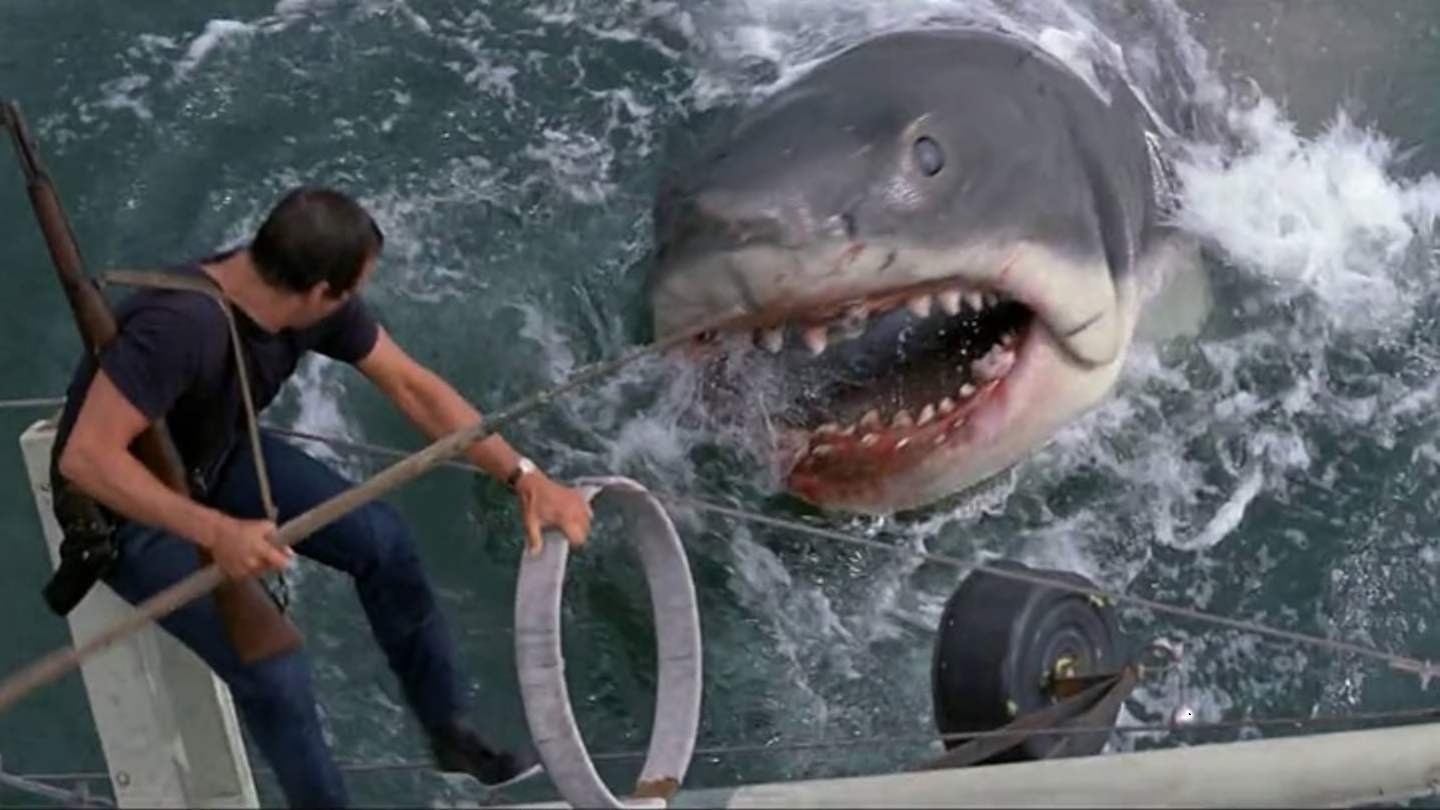
Overall, Spielberg’s style is what ends up holding the ship together. I found myself impressed with the camera tricks used to make the shark feel like a gigantic living threat, especially knowing what a pain it was to work with. The moments without the shark don’t feel slow, thanks to the tension and the chemistry between characters on screen. Despite the story being so mundane compared to the works I know Spielberg for (Indiana Jones, Jurassic Park), the presentation was thrilling, and had that familiar style I was expecting. At 2 hours and 4 minutes, Jaws doesn’t overstay its welcome, making it a great way to take on your–or your friend’s–fear of man-eating sharks. And really, isn’t that what Halloween is all about?
 Sam Wolfe is alive